What are the legal pathways to obtaining citizenship after a child turns 21?

Legal pathways to citizenship after age 21?

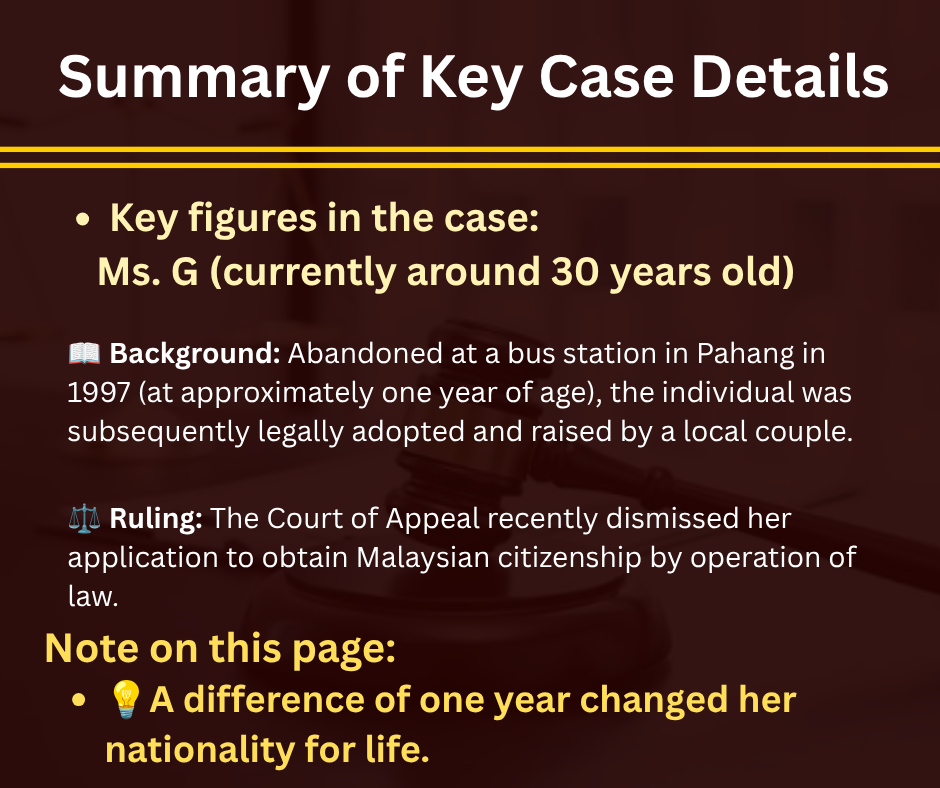
📖 Case Background

– Ms. G (approx. 30 years old) was abandoned at a bus stop at the age of one and subsequently legally adopted by a local couple.

– The Court of Appeal rejected her citizenship application because she was one year old—not a “newborn”—when found.

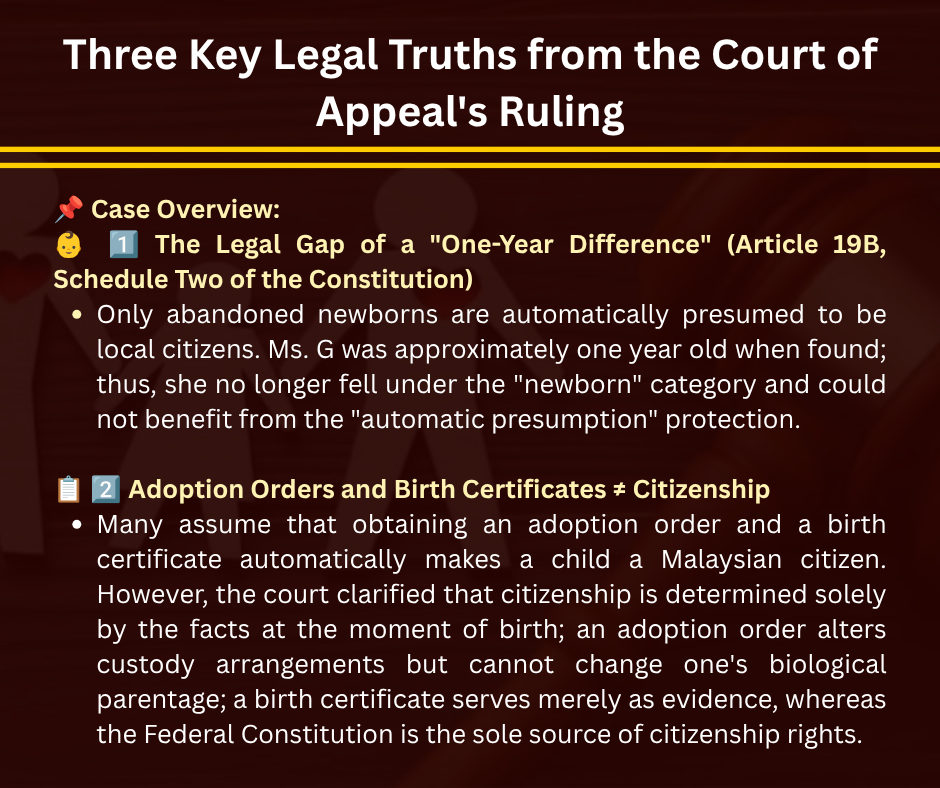
⚖️ Three Key Legal Facts

1️⃣ A world of difference in just one year (Article 19B, Second Schedule of the Constitution): Only abandoned **newborns** are automatically presumed to be Malaysian citizens; this does not apply to a one-year-old.

2️⃣ Adoption Order ≠ Citizenship: Citizenship is determined by facts at birth; adoption alters the caregiving relationship but cannot change one’s lineage or bloodline.

3️⃣ Extremely difficult burden of proof: One must prove the absence of citizenship in another country at birth, but since the biological parents are unknown, providing such proof is impossible.

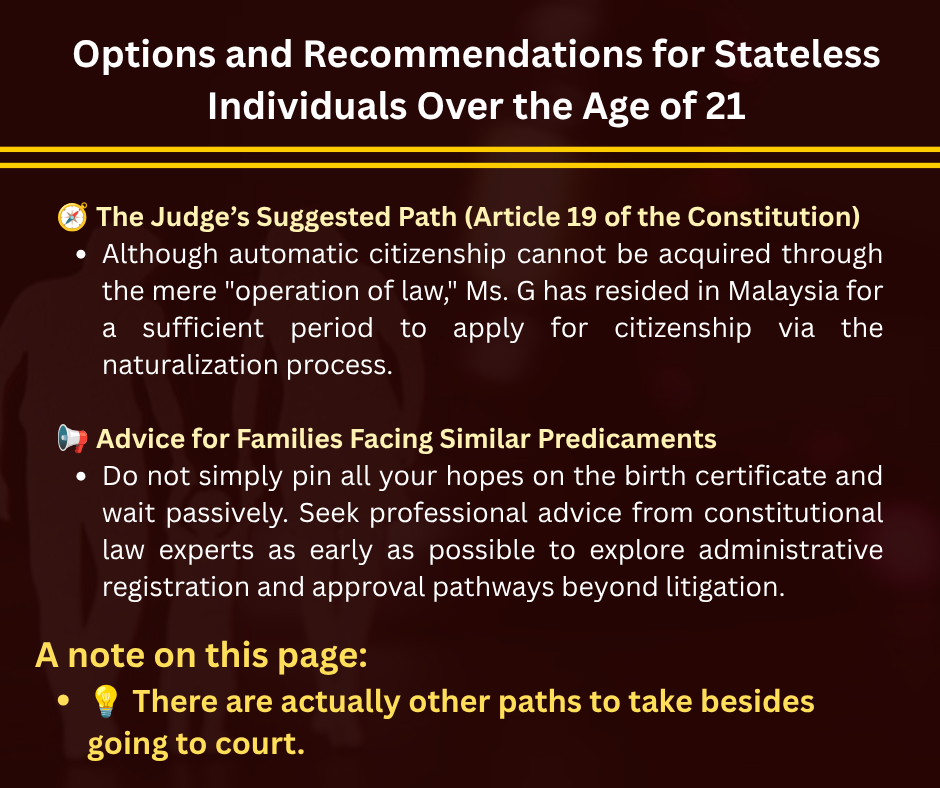
🧭 The Only Way Forward: Naturalisation (Article 19 of the Constitution)

– The path to automatic citizenship is unavailable after age 21.

– However, having resided in Malaysia for a sufficient period, one can apply to the government for **Naturalisation**.

– This is an administrative application, not a judicial process.

💡 Advice

– Do not wait until adulthood to address citizenship issues; consult a constitutional law expert early on.

– Beyond litigation, there are administrative channels for registration and approval.


Legal Article

Understanding the Special Commissioners and Tax Appeal Hearings in Malaysia

Understanding the Special Commissioners and Tax Appeal Hearings in Malaysia

Most Malaysians know that you can appeal your tax assessment if you think the Inland Revenue Board (LHDN) got it wrong. But many people do not know who actually decides those appeals and how the hearings work. This article explains , in plain language , the roles, procedures, and powers…

Understanding How a Tax Appeal Works in Malaysia

Understanding How a Tax Appeal Works in Malaysia

What Happens After You File a Tax AppealWhen a taxpayer disagrees with a tax assessment issued by the Inland Revenue Board (LHDN), the case can eventually go before a special panel known as the Special Commissioners of Income Tax. Think of them as the “judges” of Malaysia’s tax world —…
How to Appeal Your Income Tax Assessment in Malaysia — A Simple Guide

How to Appeal Your Income Tax Assessment in Malaysia — A Simple Guide

When you file your taxes, you expect the Inland Revenue Board (LHDN) to process your return correctly. But sometimes, you may receive a notice of assessment that you believe is wrong — maybe your income was overstated, or a deduction was missed. The Malaysian Income Tax Act 1967 gives you…
Understanding the Special Commissioners of Income Tax (SCIT) in Malaysia

Understanding the Special Commissioners of Income Tax (SCIT) in Malaysia

The Special Commissioners of Income Tax (SCIT) serve as an independent tribunal established under the Income Tax Act 1967. Often regarded as Malaysia’s “tax court,” the SCIT is the first level of appeal for taxpayers who wish to challenge assessments made by the Inland Revenue Board (Lembaga Hasil Dalam Negeri,…

Save Tax with Industrial Building Allowance (IBA) | Malaysia Tax Law

Save Tax with Industrial Building Allowance (IBA) | Malaysia Tax Law

Understanding Industrial Building Allowance (IBA) Under the Malaysian Income Tax Act 1967The Industrial Building Allowance (IBA) is one of the key tax incentives available to businesses in Malaysia. It allows companies to reduce their taxable income by claiming deductions for the cost of constructing or purchasing qualifying industrial buildings. This…

error: Content is protected !!
Welcome to Edward Ng & Partners! Click to consult with our lawyer! 欢迎来到爱德华·黄律师事务所,点击联系我们的律师
//
Lawyer Edward Ng 黄志威律师 황지위 변호사
Divorce, Child Adoption, Will, Probate & LA, CIPAA, Civil & Corporate Litigation, Debt Recovery, Defamation, Tax Law.
Consult Lawyer 咨询律师 상담문의