


Who Owns the Embryos After Divorce? Malaysia’s First Frozen Embryo Case Delivers a Landmark Judgment!
In 2025, the Malaysian Family High Court, in the case of RAH v RAL, addressed the legal status and control of frozen embryos following a divorce for the first time. The decision is regarded as a landmark development in Malaysian family law. Background of the Case The couple married in…

Is Surrogacy Really Allowed in Malaysia?
Many couples facing fertility difficulties may consider surrogacy as an option. However, in Malaysia, surrogacy remains a legal grey area. In simple terms, surrogacy refers to an arrangement where another person carries and gives birth to a child on behalf of the intended parents. It generally falls into two categories:…

TOP 100 Frequently Asked Questions (FAQ)
A Comprehensive Guide to Joint Petition Divorce & Single-Petitioner Divorce In practice, divorce is far more than simply signing a document. Whether the divorce is pursued by mutual agreement or initiated unilaterally by one party, the process involves legal procedures, court requirements, and careful consideration of important matters such as…

Is Adultery Hard to Prove?Can I Hire a Private Investigator to Track Them?
1. What can a wife do if the husband refuses to provide maintenance? In Malaysia, a wife may apply under: Married Women and Children (Maintenance) Act 1950 To claim: Wife’s maintenance Child maintenance Including illegitimate children The court will determine: Amount Effective date Whether retrospective payment applies 2. Is the…

After Divorce, Can I Still Claim Maintenance from My Ex Husband?
1. Can maintenance continue after divorce if it was already paid during marriage? If the husband had been consistently providing maintenance during the marriage (e.g. monthly transfers), the wife may apply to the court to continue receiving such maintenance after divorce. The key is not whether the parties are divorced,…

What Can You Do If Your Husband Refuses to Pay Maintenance?
1. Under what circumstances does it constitute “adultery”? In simple terms, adultery refers to: Two individuals engaging in consensual sexual relations, where at least one party is in an existing marriage. The key elements are: The relationship must be consensual At least one party must be married Precisely because “sexual…
My General Understanding of the Adoption System in Mainland China
In China, adopting a child tends to be more complex compared to Singapore. This is not merely a matter of procedural formality, but also reflects stricter regulatory requirements and correspondingly greater limitations. For those intending to adopt, it is important to understand these restrictions and approval processes in advance. If…
Is Hong Kong’s Child Adoption System the Same as Malaysia’s ? Part 1
If adoption is considered in Hong Kong, the process differs from that in Mainland China. Hong Kong adopts a common law system, similar to Malaysia, but the process is likewise stringent. Before adopting in Hong Kong, an application must be made to the Social Welfare Department for an “Adoption Eligibility…
For Foreign Applicants Adopting a Child, Is the Assessment Different ?
Foreign Adoption of Malaysian Children: Welfare Department Assessment Standards and Procedures In Malaysia, whether for local residents or foreigners, court adoption requires assessment by the Social Welfare Department. The question arises: are the assessment standards different for foreigners? 1) Assessment Standards Are Generally the Same The evaluation for foreign adopters…
International Adoption: What Procedures Are Required to Bring a Child from Malaysia to Singapore ? Part 2
Cross-Border Adoption: Procedures for Bringing a Child from Malaysia to Singapore After Adoption If a foreigner (e.g. a Singapore citizen) adopts a child in Malaysia and plans to bring the child to Singapore, strict legal procedures must be followed to ensure legality. Key steps include: 1) Apply for Lawful Entry…
International Adoption: What Procedures Are Required to Bring a Child from Malaysia to Singapore ? Part 1
After Foreigners Adopt a Child in Malaysia, What Should Be Noted When Bringing the Child Back to Their Home Country? If a foreigner, for example a Singapore citizen, successfully adopts a child in Malaysia and intends to bring the child back, relevant legal procedures must be carefully observed to avoid…
When Foreigners Adopt a Malaysian Child, Are There Also Two Different Procedures ?
What Are the Procedures for Foreigners to Adopt Malaysian Children? In Malaysia, there are two main legal pathways for adopting a child: 1) Court Procedure Applicable to non-Muslim children and adopters Generally faster, typically taking about 6 months or even less Upon application through the court, the adopter will obtain…
Foreigners Want to Adopt a Malaysian Child ? Key Requirements You Must Know Part 2
How Can Foreigners Legally Adopt Local Children in Malaysia? Many foreigners wish to adopt children in Malaysia, but the law imposes clear requirements regarding residence. The following points must be noted: 1) Continuous Residence for Three Months The law requires foreigners to reside in Malaysia continuously for at least three…
Foreigners Want to Adopt a Malaysian Child ? Key Requirements You Must Know Part 1
What Conditions Must Foreigners Meet to Adopt Local Children in Malaysia? Many people are curious about the requirements for foreigners wishing to adopt Malaysian children. According to Malaysian law, the main requirements are as follows: 1) Age Requirement The adopter must be at least 25 years old The adopter must…
Mainland Chinese Citizens Adopting a Malaysian Child — What Procedures Are Required to Bring the Child Back to China ?
What Procedures Should Citizens of Mainland China Observe When Adopting a Malaysian Child? If a citizen of Mainland China intends to adopt a Malaysian child and bring the child back to China, a series of procedures must be followed: 1) Complete the Adoption Process in Malaysia Adoption must be carried…
One Party Is a Foreigner and the Other Is Malaysian — Is This Considered an International Adoption ?
What Situations Are Considered “Foreign Adoption”? When discussing “foreign adoption,” many people have a common question: Does it count as foreign adoption as long as one party is a foreigner? In fact, the answer depends on the situation. Generally, it can be divided into two categories. First situation: One spouse…
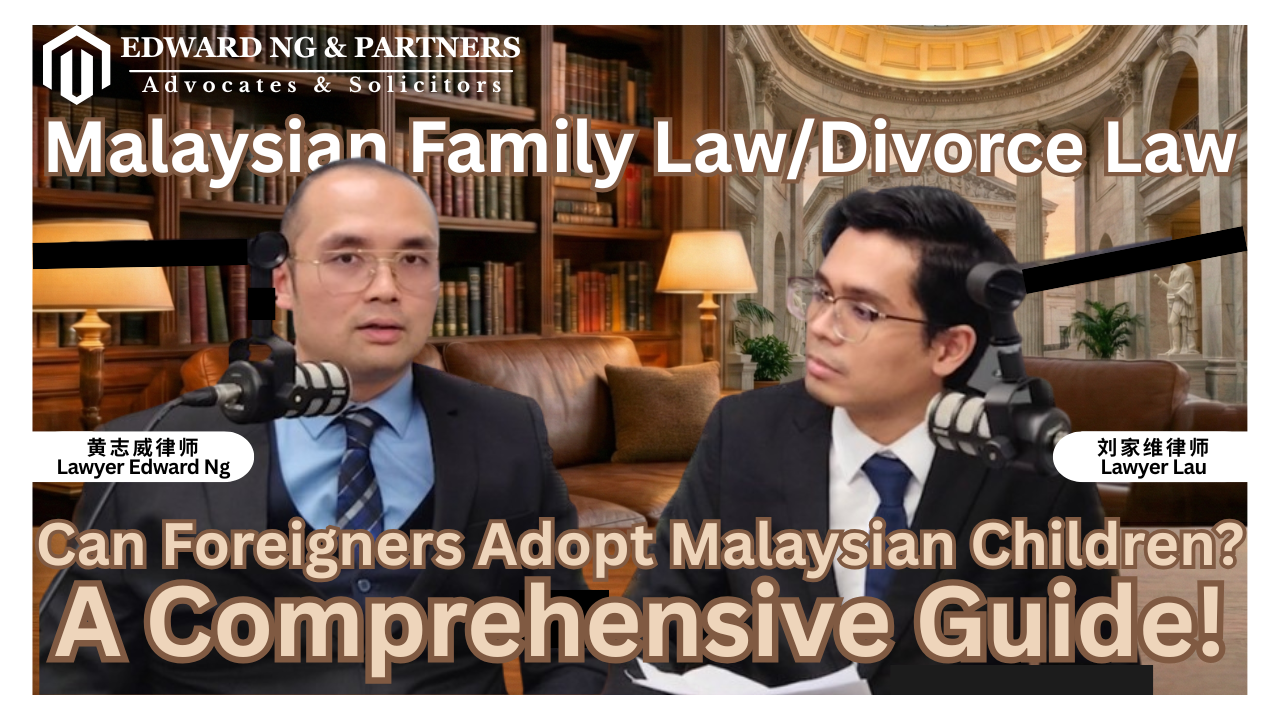
How Can Foreigners Adopt a Child in Malaysia ? A Complete Step-by-Step Guide !
This Episode Discusses a More “Cross-Border” Issue: Can Foreigners Adopt Malaysian Children in Malaysia? What Procedures and Key Considerations Are Involved if the Child Is Later Taken Abroad? 1) First Clarify: What Is Meant by “Foreign Adoption”? It can generally be divided into two situations: (A) One spouse is a…
What If the Other Party Converts to Islam During the Tribunal Exemption Process?
In matrimonial matters, a common question arises: if one party is in the process of applying for a “tribunal exemption,” and the other party suddenly converts to Islam, will this affect the divorce proceedings? First, it depends on the stage of the process. If the exemption application has just begun…
If You Have Already Gone to Court for Child Custody, Can You Skip JPN in Divorce Proceedings?Part 2
Many people attempt to link “custody orders” with “divorce proceedings,” assuming that if both parties are already complying with a custody order, the divorce process should become simpler, or even qualify for procedural exemptions. However, in essence, these remain separate matters. If both parties comply with the custody order—maintenance is…
If You Have Already Gone to Court for Child Custody, Can You Skip JPN in Divorce Proceedings?Part 1
In handling family matters, many people tend to confuse “child custody” with “divorce.” However, in law, these are entirely separate procedures. Some parents, even before divorce, have already applied for and obtained a court order regarding child custody. Such orders may include guardianship, visitation rights, and even maintenance (child support)…
If One Party Is Living Overseas and Not Returning to Malaysia, Can This Be a Ground for Divorce?
Can a Partner Living Overseas for a Long Period Constitute a “Special Circumstance”? There are indeed such situations: The other party has been living abroad for many years It is confirmed that the person is in a certain country It is even known that the person holds residency rights in…

Does the Other Party’s Imprisonment Affect Divorce?
In legal proceedings, certain situations may allow exemption from mediation or special procedural treatment, one of which is the other party being in prison. However, not all imprisonment cases qualify, as the law sets clear conditions. Imprisonment as a “Special Circumstance” Condition The law generally stipulates: imprisonment of five years…
Special Circumstances in Divorce: Do Domestic Violence or Emotional Abuse Count? Uncovering the Grey Areas!Part 2
In legal proceedings, domestic violence does not only refer to physical harm; psychological abuse may also be regarded as a “special circumstance.” However, the key issue in law is evidence. Can Psychological Abuse Be Considered a “Special Circumstance”? In principle: yes, because psychological abuse can also cause serious stress, anxiety,…
Special Circumstances in Divorce: Do Domestic Violence or Emotional Abuse Count? Uncovering the Grey Areas!Part 1
What is a “Special Circumstance”? The law does not provide a complete list specifying which situations are definitively considered “special circumstances” It is a broad and undefined concept Judges exercise discretionary power based on the facts of each individual case The key issue is whether there are sufficient reasons to…

Does Divorce Require Court Approval? Key Factors You Must Know!
When applying to the court for exemption from mediation, valid and sufficient reasons must be provided—especially when the law ordinarily requires mediation first. “Special circumstances” is a broad legal concept, assessed based on the facts of each case. The law provides some clearer examples: The other party is serving a…

Is Your Divorce Being Delayed by the Other Party? What If They Don’t Attend JPN?
Many people worry: If the other party refuses to attend mediation, does that mean divorce becomes impossible? The answer is: No. If you initiate mediation and the other party repeatedly fails to attend, the relevant authority will issue a Sijil confirming their absence. This document is crucial because it can…

Divorce Mediation: Does Going Three Consecutive Days Count as Three Visits? Is This Allowed?
Many people further ask: “How are the three sessions counted? Is it once per month? Can it be completed in three consecutive days?” There is often misunderstanding about this. These sessions are not freely scheduled nor designed to be completed in a short period. They are not merely procedural steps…

Do You Really Need to Go to JPN Three Times for Divorce? This Might Be Simpler!Part 2
Many people ask: “Do I have to attend JPN three times before I can proceed with a unilateral divorce?” The answer is: not necessarily. There is a common belief that three visits are mandatory, but in practice, not every case follows the same pattern. Is Three Attendance Sessions Mandatory? In…