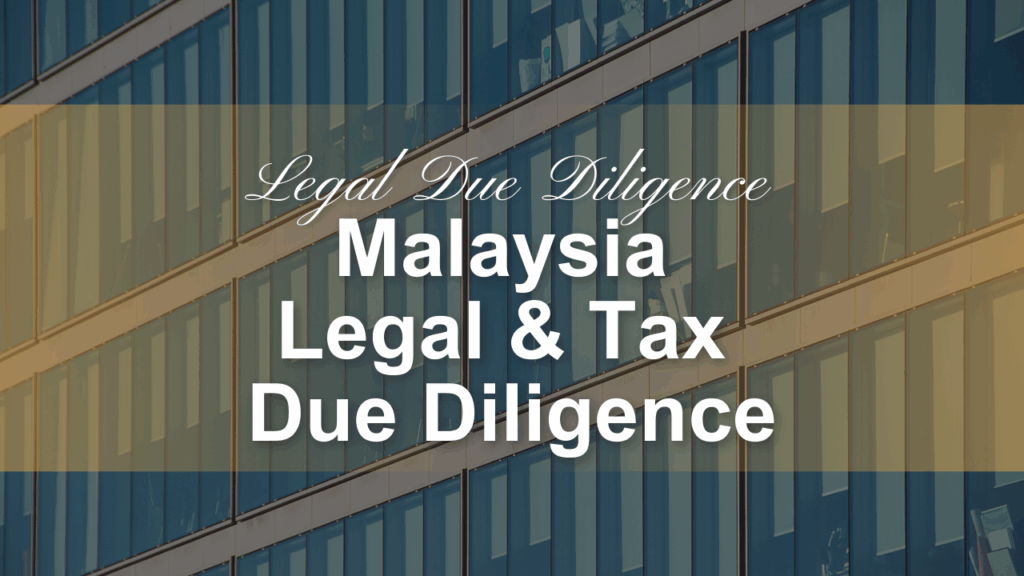
Malaysia Legal & Tax Due Diligence:
An in-depth analysis every cross-border investor and acquirer must read

Malaysia Legal & Tax Due Diligence (Legal + Tax Due Diligence)

— An in-depth analysis that cross-border investors and acquirers must read


I. Introduction: Why must Malaysian transactions conduct “Legal + Tax” dual due diligence?

On the surface, Malaysia is a common-law jurisdiction with a mature legal system, clear regulation, and a business-friendly environment.
Many foreign companies assume:
• A valid contract is enough
• Audited financial statements being true is enough
• Accurate company registration information is enough

Reality is far more complex.
Malaysia’s risks are not usually obvious illegality, but are hidden in:
• Fragmented regulation (multiple regulators operating in parallel)
• Strong tax traceability (LHDN can reopen accounts for many past years)
• Uneven corporate compliance standards
• Incomplete documentation, approvals, and licences
• Key contracts containing hidden termination rights
• Complex HR and foreign-labour regimes
• State-by-state differences in land policy
• Audited accounts that do not reflect tax risks

More importantly:
Once you acquire shares (share acquisition), you not only buy the company — you also buy all of its past 5–10 years of legal liabilities + tax risks.
Therefore, when top-tier foreign investors enter the Malaysian market,
Legal Due Diligence (LDD) + Tax Due Diligence (TDD) is an indispensable “double insurance”.


II. What are Legal Due Diligence and Tax Due Diligence?

• Legal Due Diligence (LDD): confirms the company is lawful, compliant, enforceable, acquirable, and free from hidden legal risks.
• Tax Due Diligence (TDD): confirms the company’s tax health, no unpaid tax, no hidden tax “bombs” that may be pursued later, and no flawed structures.

Together, they answer one ultimate question:
“Are you buying a real business — or a well-packaged time bomb?”


III. Legal Due Diligence (LDD) — a professional analytical framework of top legal minds


1. Corporate structure and shareholding: the legal DNA of the business

A truly professional LDD does not merely review SSM filings, but goes deeper into:
• Is the shareholding clean? Are there shadow shareholders?
• Are there unregistered share transfers?
• Are there undisclosed pledges, charges, or freezes?
• Does the company’s Constitution restrict foreign ownership?
• Do founders privately retain control rights?
• Do shareholder agreements contain veto rights, pre-emption rights, drag-along rights, tag-along rights, etc.?

Risk point:
Defects in the shareholding structure can cause the legality of the entire transaction to be challenged.


2. Regulatory licences and compliance: the minefield most foreign investors miss

Malaysia’s regulatory framework is diverse, with different authorities for different industries:
• Financial industry → BNM
• Securities, funds, digital assets → SC
• Manufacturing → MIDA
• Import/export → MITI + Customs
• F&B, logistics, warehousing → local authorities
• Land → state land offices
• Specific industries → licences under specific Acts

A professional LDD will check:
• Are licences genuine, valid, and transferable?
• Is the licence held by the “wrong entity”?
• Is the licence dependent on specific directors or shareholders?
• Is there “unlicensed operation that simply hasn’t been caught”?

Reality:
Many Malaysian businesses operate in a grey area on licences; once acquired by a foreign company, regulators tend to scrutinise more strictly and risks surface immediately.


3. Contract review: the key part that determines a company’s real value

A professional LDD will:
• Review the top 10 customer contracts
• The top 10 supplier agreements
• Distribution, agency, franchise agreements
• IT systems and software usage rights
• Loan, guarantee, and lease contracts

Key focus:
• Do contracts automatically terminate upon a change in controlling shareholding?
• Are contracts enforceable?
• Are there asymmetric liability clauses?
• Are assignments to a new company prohibited?

Major risk:
Many foreign buyers only discover after acquisition that the most important customer contract states:
“If the company’s shareholding changes, this contract may be terminated immediately.”
This can cause the acquisition to lose its revenue base instantly.


4. Land, assets, real estate, and zoning compliance

Including:
• Does the land have a caveat (registered caution)?
• Is it charged/mortgaged?
• Is foreign ownership permitted?
• Has the factory been illegally extended?
• Does the zoning allow the relevant use?
• Are fire safety and building compliance documents missing?

Risk point:
Many warehouses and factories operate “in a grey state”; foreign acquisitions often trigger real regulatory inspections.


5. Intellectual Property (IP): often the most valuable asset — yet it may not belong to the company

Check:
• Are trademarks registered under the company’s name?
• Does the company truly own the software?
• Are there third-party rights over the technology?
• Do founders retain IP instead of transferring it to the company?

Common issue:
More than 40% of Malaysian companies register their brands under the founder’s personal name rather than the company.
This means:
“The company you bought does not own the brand.”


6. Employment, HR, and foreign labour: the area with the most hidden legal risks

LDD checks:
• Are employment contracts lawful?
• Do foreign workers have valid permits?
• Are EPF/SOCSO/EIS contributions fully and timely paid?
• Are there pending labour disputes?
• Is there illegal outsourcing?

Special risk:
Malaysian labour law allows the court to order “reinstatement”, meaning an employee may be ordered back into the company to continue working.


7. Litigation, investigations, and potential legal risks

Including:
• Civil litigation
• Arbitration
• Tax audits
• Regulatory investigations
• Environmental penalties
• Operational breaches

A professional LDD assesses:
“Will these disputes erupt in the coming years and swallow your investment value?”


IV. Tax Due Diligence (TDD) — a deep analytical framework of top tax minds


1. Corporate Tax: a tax health check of the business

Check:
• Are corporate tax filings accurate?
• Are adjustment items lawful?
• Is any income underreported?
• Are expenses fabricated or costs overstated?
• Has the company been pursued by LHDN for additional tax?
• Are there Form JA (additional assessments)?
• Are there long-term losses without reasonable explanation?

Tax reality:
Many companies keep “two sets of books” — internal and external.
Compliance levels vary widely.


2. Indirect tax: SST, GST legacy issues, and customs duties

Check:
• Should the company have registered for SST but did not?
• Is service tax correctly charged?
• Are there under-declarations during the GST period?
• Are customs declarations under-declared or misdeclared?
• Are tax exemptions applied incorrectly?

High risk:
Customs penalties are among Malaysia’s heaviest enforcement actions and can far exceed the tax amount itself.


3. Withholding Tax (WHT): a high-risk point for all multinational groups

WHT involves:
• Software fees
• Technical service fees
• Interest payments
• Royalties
• Contract payments
• Contracting services
• Management fees paid to an overseas parent company

TDD confirms:
• Was tax withheld when it should have been?
• Was the DTA (Double Taxation Agreement) applied correctly?
• Are there artificial structures to avoid WHT?

Tax reality:
Once WHT is not withheld, LHDN can demand back tax + penalties + interest.


4. Transfer Pricing: one of the most frequently audited areas in Malaysia

Including:
• Pricing of related-party transactions
• Reasonableness of management fees and royalties
• Interest on intercompany loans
• Whether TP documentation exists
• Compliance with the arm’s length principle

Risk:
TP adjustments can multiply taxable income several times over.


5. Real Property Gains Tax (RPGT) and Real Property Company (RPC)

TDD checks:
• Was RPGT declared in the past?
• Is the company defined as an RPC?
• Are there tax risks tied to high-value land?
• Is any property transfer suspected of circumventing RPGT?


6. Tax incentives: once non-compliant, they can be clawed back

Including:
• Pioneer Status
• Investment Tax Allowance
• Reinvestment Allowance
• MIDA industry-specific incentives

TDD confirms:
• Is the company truly eligible?
• Is it continuously compliant?
• Could MIDA revoke the incentives?


7. Tax audits, investigations, and unresolved disputes

Including:
• Desk Audit
• Field Audit
• Custom Probe
• GST Probe
• Form Q / Form N appeals
• Judicial Review (JR)
• Unsettled additional assessments

Risk:
After a share acquisition, these disputes automatically “follow” the company and transfer to the new buyer.


V. How do legal and tax DD affect transaction structure? (SPA / JVA practice)

DD findings usually directly change:


1. Purchase Price

• If risks are found → demand a price reduction
• If uncertain → use earn-out or deferred consideration


2. Seller Indemnities

Commonly include:
• Tax indemnities
• Compliance indemnities
• Contract indemnities
• Litigation indemnities
• Employment indemnities


3. Conditions Precedent (CP)

For example:
• Obtain licences
• Clear tax audits
• Renew contracts
• Transfer IP
• Resolve HR non-compliance issues


4. Retention / Escrow

Typically:
• 10%–30% of the purchase price
• For 1–3 years

Used to cover:
• Tax recoveries
• Litigation
• Undisclosed liabilities
• Compliance risks


VI. Conclusion: In Malaysia, due diligence is not a cost — it is the “airbag” that protects your investment value

Malaysia is one of ASEAN’s most promising investment destinations, but it is also a market where legal and tax risks are deeply hidden and regulatory enforcement often hits hard later.
If foreign investors conduct a complete LDD + TDD:
• Safer transactions
• Stronger negotiation position
• More controllable risks
• More precise valuation
• Smoother post-acquisition integration
• More assured investment returns

If due diligence is ignored, you may face:
• Tax bombs
• Licence revocations
• Customer contracts becoming ineffective
• HR disputes
• Chain litigation blow-ups
• Assets that cannot be lawfully used
• IP not held under the company’s name
• Erosion of investment value

In Malaysia, due diligence is not a “formality”.
It is the investor’s first firewall.


Legal Articles

Litigation Clerk Vacancy

Litigation Clerk Vacancy

VACANCY Available – Litigation Clerk BY Messrs. Edward Ng & Partners – Legal Firm Location: Bukit Bintang, Kuala Lumpur Type of Position: Full Time Qualifications & Requirements * Minimum 1 year of litigation experience, preferably in small to mid-sized firms * Ability to work independently with minimal supervision * High…
Is Adultery Hard to Prove?Can I Hire a Private Investigator to Track Them?

Is Adultery Hard to Prove?Can I Hire a Private Investigator to Track Them?

1. What can a wife do if the husband refuses to provide maintenance? In Malaysia, a wife may apply under: Married Women and Children (Maintenance) Act 1950 To claim: Wife’s maintenance Child maintenance Including illegitimate children The court will determine: Amount Effective date Whether retrospective payment applies 2. Is the…
After Divorce, Can I Still Claim Maintenance from My Ex Husband?

After Divorce, Can I Still Claim Maintenance from My Ex Husband?

1. Can maintenance continue after divorce if it was already paid during marriage? If the husband had been consistently providing maintenance during the marriage (e.g. monthly transfers), the wife may apply to the court to continue receiving such maintenance after divorce. The key is not whether the parties are divorced,…
What Can You Do If Your Husband Refuses to Pay Maintenance?

What Can You Do If Your Husband Refuses to Pay Maintenance?

1. Under what circumstances does it constitute “adultery”? In simple terms, adultery refers to: Two individuals engaging in consensual sexual relations, where at least one party is in an existing marriage. The key elements are: The relationship must be consensual At least one party must be married Precisely because “sexual…
Can There Be More Than One Estate Administrator!? How Does the Court Decide?

Can There Be More Than One Estate Administrator!? How Does the Court Decide?

In Malaysia, it is commonly assumed that only one estate administrator can be appointed. However, this is not strictly the case. The court has the discretion to appoint more than one administrator depending on the circumstances of the estate. How many administrators can the court appoint at most? Generally, the…
Must the Estate Administrator Be a Family Member?

Must the Estate Administrator Be a Family Member?

In estate disputes, the purpose of appointing an interim administrator is to stabilise assets, preserve the status quo, and prevent misuse. In practice, courts may appoint a third party rather than family members when it is deemed that entrusting management to family members is no longer safe or feasible. Why…
Can You Collect Rental Income Privately Before Being Appointed as an Estate Administrator?

Can You Collect Rental Income Privately Before Being Appointed as an Estate Administrator?

In some intestate estate disputes, it is common for one party to act unilaterally before any administrator is formally appointed, for example by collecting rental income from tenants belonging to the estate. In principle, without lawful authority (such as being appointed executor or administrator, or obtaining a court order), any…
If You Appoint Amanah Raya as a Temporary Estate Administrator, Will the Fees Be Lower?

If You Appoint Amanah Raya as a Temporary Estate Administrator, Will the Fees Be Lower?

In many estate disputes, what causes the process to stall is not “how to divide the estate”, but “who should manage it”. When family members do not trust each other or cannot reach agreement, and multiple parties insist on being appointed, the court may, in certain circumstances, prefer appointing a…
What to do if siblings can't agree on the division of inheritance?

What to do if siblings can't agree on the division of inheritance?

In estate administration cases, one of the most common and conflict-prone issues is: who should be responsible for managing the estate. This becomes especially sensitive when the deceased left behind substantial assets such as multiple properties, bank savings, investments, or other forms of wealth. In such situations, it is not…
Siblings Disputing Over Estate Administrator? What Factors Does the Court Usually Consider?

Siblings Disputing Over Estate Administrator? What Factors Does the Court Usually Consider?

This Episode: Who Should Be the Administrator of an Estate? How Does the Court Decide? In this episode, we discuss an issue that many families encounter, but which often escalates into court disputes: who should be appointed as the Administrator of an estate, and what factors does the court consider?…
In Malaysian Law, If the Other Party Has No Evidence = Do I Automatically Win?Part 2

In Malaysian Law, If the Other Party Has No Evidence = Do I Automatically Win?Part 2

Many people ask: if the opposing party allegedly has evidence but chooses not to produce it in court, is there any legal principle addressing this situation in Malaysia? It must be stated carefully: This does not mean that failure to produce evidence automatically benefits one party or harms the other.…
In Malaysian Law, If the Other Party Has No Evidence = Do I Automatically Win? Part 1

In Malaysian Law, If the Other Party Has No Evidence = Do I Automatically Win? Part 1

To make this case easier to understand, it is helpful to break down the facts in a clearer, structured way. Our client was one of the contractors in the project, responsible for a specific portion of the works. The dispute ultimately revolved around two main issues: whether the works were…
From Trial to Appeal: If Evidence Is Insufficient, Is the Outcome Already Determined?

From Trial to Appeal: If Evidence Is Insufficient, Is the Outcome Already Determined?

From the beginning of the case being heard at the lower court, to the other party appealing to the High Court (Appellate Court), and subsequently failing to provide sufficient evidence in their counterclaim and not calling key witnesses, this entire case actually delivers a very realistic and important lesson: When…
What Kind of Evidence Can Prove That a Third Party Has Made Payment? Part 2

What Kind of Evidence Can Prove That a Third Party Has Made Payment? Part 2

Further Clarification: Why the Evidence Was Still Insufficient The opposing party’s evidence consisted mainly of: Bank payment vouchers / payment proof Quotations Transfer records While these may appear sufficient on the surface, the issue is that they do not clearly establish that the costs were incurred for “this specific rectification…
What Kind of Evidence Can Prove That a Third Party Has Made Payment?Part 1

What Kind of Evidence Can Prove That a Third Party Has Made Payment?Part 1

Key Issue with the Counterclaim: Insufficient Evidence and an Incomplete Chain Many people ask: since the opposing party claimed they engaged a third party and incurred significant costs, did they produce evidence? The answer is: they did submit some documents. However, based on the lower court’s judgment, the main issue…
How Does the Court of Appeal View Debt Recovery Cases? Part 2

How Does the Court of Appeal View Debt Recovery Cases? Part 2

To make this case easier to understand, the facts are set out more clearly below. Our client was one of the contractors in the project, responsible for a specific portion of the works. The dispute ultimately centred on two key issues: 📌 Whether the works were completed on time 📌…
How Does the Court of Appeal View Debt Recovery Cases? Part 1

How Does the Court of Appeal View Debt Recovery Cases? Part 1

Many people assume that “winning a lawsuit” means it ends in a single round. In reality, many cases go through two levels: The first level is heard in the lower courts (e.g. Magistrates’ Court / Sessions Court); the second level, if the losing party is dissatisfied, is an appeal to…
My General Understanding of the Adoption System in Mainland China

My General Understanding of the Adoption System in Mainland China

In China, adopting a child tends to be more complex compared to Singapore. This is not merely a matter of procedural formality, but also reflects stricter regulatory requirements and correspondingly greater limitations. For those intending to adopt, it is important to understand these restrictions and approval processes in advance. If…
Is Hong Kong’s Child Adoption System the Same as Malaysia’s ? Part 1

Is Hong Kong’s Child Adoption System the Same as Malaysia’s ? Part 1

If adoption is considered in Hong Kong, the process differs from that in Mainland China. Hong Kong adopts a common law system, similar to Malaysia, but the process is likewise stringent. Before adopting in Hong Kong, an application must be made to the Social Welfare Department for an “Adoption Eligibility…
For Foreign Applicants Adopting a Child, Is the Assessment Different ?

For Foreign Applicants Adopting a Child, Is the Assessment Different ?

Foreign Adoption of Malaysian Children: Welfare Department Assessment Standards and Procedures In Malaysia, whether for local residents or foreigners, court adoption requires assessment by the Social Welfare Department. The question arises: are the assessment standards different for foreigners? 1) Assessment Standards Are Generally the Same The evaluation for foreign adopters…
International Adoption: What Procedures Are Required to Bring a Child from Malaysia to Singapore ? Part 2

International Adoption: What Procedures Are Required to Bring a Child from Malaysia to Singapore ? Part 2

Cross-Border Adoption: Procedures for Bringing a Child from Malaysia to Singapore After Adoption If a foreigner (e.g. a Singapore citizen) adopts a child in Malaysia and plans to bring the child to Singapore, strict legal procedures must be followed to ensure legality. Key steps include: 1) Apply for Lawful Entry…
International Adoption: What Procedures Are Required to Bring a Child from Malaysia to Singapore ? Part 1

International Adoption: What Procedures Are Required to Bring a Child from Malaysia to Singapore ? Part 1

After Foreigners Adopt a Child in Malaysia, What Should Be Noted When Bringing the Child Back to Their Home Country? If a foreigner, for example a Singapore citizen, successfully adopts a child in Malaysia and intends to bring the child back, relevant legal procedures must be carefully observed to avoid…
When Foreigners Adopt a Malaysian Child, Are There Also Two Different Procedures ?

When Foreigners Adopt a Malaysian Child, Are There Also Two Different Procedures ?

What Are the Procedures for Foreigners to Adopt Malaysian Children? In Malaysia, there are two main legal pathways for adopting a child: 1) Court Procedure Applicable to non-Muslim children and adopters Generally faster, typically taking about 6 months or even less Upon application through the court, the adopter will obtain…
Foreigners Want to Adopt a Malaysian Child ? Key Requirements You Must Know Part 2

Foreigners Want to Adopt a Malaysian Child ? Key Requirements You Must Know Part 2

How Can Foreigners Legally Adopt Local Children in Malaysia? Many foreigners wish to adopt children in Malaysia, but the law imposes clear requirements regarding residence. The following points must be noted: 1) Continuous Residence for Three Months The law requires foreigners to reside in Malaysia continuously for at least three…
Foreigners Want to Adopt a Malaysian Child ? Key Requirements You Must Know Part 1

Foreigners Want to Adopt a Malaysian Child ? Key Requirements You Must Know Part 1

What Conditions Must Foreigners Meet to Adopt Local Children in Malaysia? Many people are curious about the requirements for foreigners wishing to adopt Malaysian children. According to Malaysian law, the main requirements are as follows: 1) Age Requirement The adopter must be at least 25 years old The adopter must…
Mainland Chinese Citizens Adopting a Malaysian Child — What Procedures Are Required to Bring the Child Back to China ?

Mainland Chinese Citizens Adopting a Malaysian Child — What Procedures Are Required to Bring the Child Back to China ?

What Procedures Should Citizens of Mainland China Observe When Adopting a Malaysian Child? If a citizen of Mainland China intends to adopt a Malaysian child and bring the child back to China, a series of procedures must be followed: 1) Complete the Adoption Process in Malaysia Adoption must be carried…
One Party Is a Foreigner and the Other Is Malaysian — Is This Considered an International Adoption ?

One Party Is a Foreigner and the Other Is Malaysian — Is This Considered an International Adoption ?

What Situations Are Considered “Foreign Adoption”? When discussing “foreign adoption,” many people have a common question: Does it count as foreign adoption as long as one party is a foreigner? In fact, the answer depends on the situation. Generally, it can be divided into two categories. First situation: One spouse…
How Can Foreigners Adopt a Child in Malaysia ? A Complete Step-by-Step Guide !

How Can Foreigners Adopt a Child in Malaysia ? A Complete Step-by-Step Guide !

This Episode Discusses a More “Cross-Border” Issue: Can Foreigners Adopt Malaysian Children in Malaysia? What Procedures and Key Considerations Are Involved if the Child Is Later Taken Abroad? 1) First Clarify: What Is Meant by “Foreign Adoption”? It can generally be divided into two situations: (A) One spouse is a…
error: Content is protected !!
Welcome to Edward Ng & Partners! Click to consult with our lawyer! 欢迎来到爱德华·黄律师事务所,点击联系我们的律师
//
Lawyer Edward Ng 黄志威律师 황지위 변호사
Divorce, Child Adoption, Will, Probate & LA, CIPAA, Civil & Corporate Litigation, Debt Recovery, Defamation, Tax Law.
Consult Lawyer 咨询律师 상담문의