


Award-Winning Divorce Law Firm
(Selangor/KL)

Edward Ng & Partners is proud to be recognized for its excellence in legal services and commitment to delivering outstanding results for clients. Our firm has been nominated as the top Finalist at the ALB Malaysia Law Awards 2026 in the category of “Matrimonial and Family Law Firm of the Year”!

Divorce Service

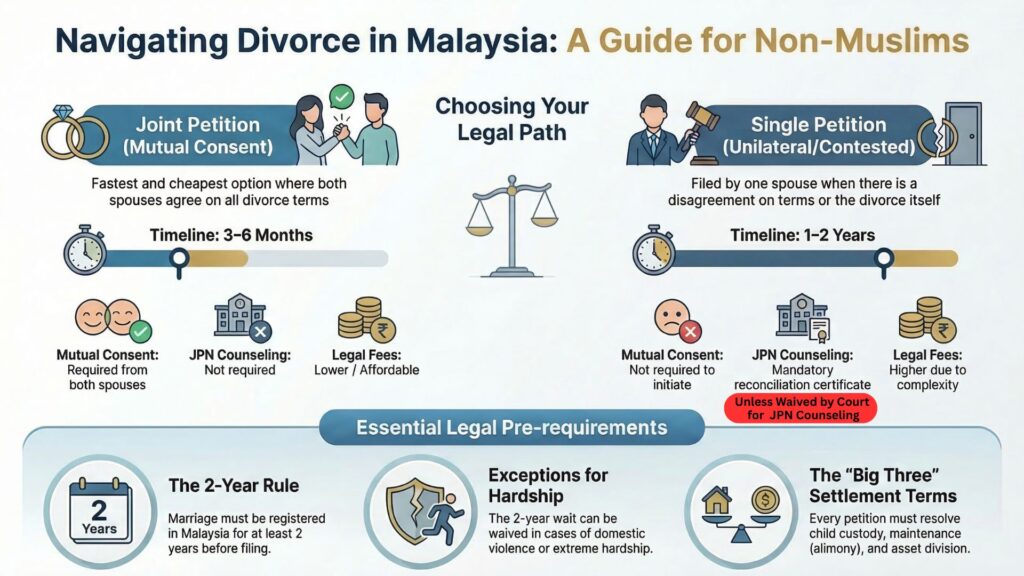
Simple Guideline to conclude method for divorce in Malaysia. 

Our Services and Expertise

Edward Ng & Partners specializes in non-Muslim family law in Malaysia, offering comprehensive divorce and child custody services. With decades of combined experience, our Kuala Lumpur & Puchong, Selangor-based lawyers assist with all aspects of civil divorce – from uncontested (joint petition) and contested (single petition) divorces to judicial separation and annulments. We also handle related matters like child custody, access (visitation), maintenance (alimony), and division of matrimonial assets under the Law Reform (Marriage and Divorce) Act 1976 (LRA 1976). Our goal is to guide you through Malaysia’s civil court process clearly and compassionately.

Key highlights of our practice:

  • Divorce Consultation & Filing: Guidance on grounds for divorce and preparation of petitions.
  • Child Custody & Support: Negotiation or litigation for custody, access, and child maintenance (support).
  • Ancillary Relief: Legal help with asset division, spousal maintenance, and protective orders.
  • Experienced Family Lawyers: Specialist advocates dedicated to family law matters.
  • Personalized Strategy: We tailor our legal approach to your situation and goals.
  • Other methods: We also assist client in judicial separation and annulment of marriage.

Grounds for Divorce: Contested vs. Uncontested

Malaysian non-Muslim divorce law (LRA 1976) treats all divorces under a single ground: irretrievable breakdown of the marriage. Practically, this is proven by specific facts. There are two main petition types:

  • Uncontested Divorce (Joint Petition): Both spouses agree to end the marriage and consent to the terms. This streamlines the process. Requirements include mutual agreement on issues like child custody and asset division, and a minimum marriage duration of 2 years (unless hardship proven).

  • Contested Divorce (Single Petition): One spouse files alone (the petitioner), and the other (respondent) may contest. The petitioner must demonstrate the marriage has broken down, by alleging one of the “LRA factors”:

    • Adultery: One spouse had a sexual relationship outside marriage. The innocent spouse must prove this.
    • Unreasonable Behaviors/Cruelty: Conduct making it intolerable to continue cohabitation (e.g. abuse, neglect).
    • Desertion: One spouse left the other for 2+ years without consent or reasonable excuse.
    • Two Years Separation: (In practice for contested petitions when both live apart knowingly.)
    • Two Years Mutual Separation: If both spouses have been living apart for 2 years and both agree to divorce (rarely used except in contested context).

In essence, contested divorce requires evidence of one spouse’s misconduct or prolonged separation, whereas uncontested divorce requires mutual consent and two years of marriage unless waived in certain conditions.

Divorce Process and Timeline

We guide clients through every procedural step of the civil divorce process in Malaysia:

  1. Initial Consultation: We discuss your situation, explain options (joint vs single petition), and plan strategy.
  2. Prepare Petition: Our lawyers draft the divorce petition (joint or single), including affidavits on facts (e.g. separation, misconduct), and ancillary clauses (custody, maintenance).
  3. File Petition with High Court: The petition is filed in the High Court (Family Division). 
  4. Service on Spouse (Contested only): If single petition, the petition is served to the respondent with a hearing date.
  5. Conciliation (Contested): For contested cases, the court orders a mandatory 3-month conciliation (LRA Section 87) to explore reconciliation or settlement. Our team represents you during these conferences.
  6. Case Management & Directions: Courts may issue case management orders to schedule hearings, submit evidence, etc.
  7. Substantive Hearing (Contested only): If divorce remains contested, hearings are held, evidence is presented, and the judge hears witnesses.
  8. Decree Nisi: If the court is satisfied, it pronounces a Decree Nisi (interim divorce order). This may take 6–12 months for contested cases.
  9. Decree Absolute: After 3 months from decree nisi (and upon application), the Decree Absolute is granted, finalizing the divorce.

For joint petitions, the process is faster: there is no contested hearing and often no need for conciliation. Typically, a joint petition can take about 2–6 months total. Contested divorces often take 9–18 months or more, depending on court schedules and case complexity. Throughout, we expedite paperwork and advocate vigorously to minimize delays.

Jurisdiction Requirements

All civil (non-Muslim) divorces are heard in the High Court of Malaysia (Family Division). Under Sections 48–49 of the LRA 1976, jurisdiction exists if one of the parties is:

  • Domiciled in Malaysia (regardless of marriage location), or
  • Habitually residing in Malaysia at the time of filing.

In practice, at least one spouse should have Malaysian residency or citizenship. Both joint and single petitions fall under High Court jurisdiction; there are no lower court options for non-Muslim divorce. Our office assists with venue selection (usually Kuala Lumpur High Court & Shah Alam Court) and ensures jurisdictional compliance.

Child Custody & Access (Visitation)

In any divorce, the children’s welfare is paramount. Malaysian law (Guardianship of Infants Act 1961 and LRA 1976) presumes that a young child’s best interests are served by living with the mother – particularly children under age 7. However, this presumption is rebuttable: a court may award custody to the father or grant joint custody if evidence shows it benefits the child.

Types of custody orders include:

  • Sole Custody: One parent (usually mother) has physical custody and guardianship, making day-to-day decisions.
  • Joint/Shared Custody: Both parents share parenting duties (rare in practice, but possible by agreement).
  • Primary Custody with Visitation: One parent has custody; the other has court-ordered access rights.

We represent parents in negotiations or trials, presenting evidence on each parent’s ability to care for the child. The court factors include each parent’s character, parenting capacity, living environment, employment, and the child’s wishes (if mature).

For the non-custodial parent, access rights (sometimes called visitation) are vital. Courts typically grant reasonable visitation (e.g. alternate weekends, holidays), unless there are safety concerns. We ensure access orders are clear (times, supervision if needed) to protect your relationship with the child.

Child & Spousal Maintenance

Under the LRA 1976, both parents are legally obligated to support their children financially. There is no lump-sum payment for child support – only periodic payments until the child reaches adulthood (usually age 18 or graduation). To set child maintenance, the court considers: parents’ incomes and expenses, number of children, their educational needs, and each parent’s capacity. If a court order is violated, our firm can help enforce it via the maintenance enforcement mechanisms.

For spousal maintenance (alimony), Section 76 of the LRA allows a spouse to claim support if they cannot sustain themselves post-divorce. Factors include the length of marriage, each spouse’s contributions, age/health, and standard of living during marriage. Spousal maintenance is less common and is decided on a case-by-case basis. We assist clients on negotiating fair maintenance provisions during divorce or seeking court orders if necessary.

Division of Matrimonial Assets

Under Section 76(7) of the LRA 1976, the court can order transfer or sale of matrimonial property so that each party gets a fair share. “Matrimonial assets” typically include the family home, vehicles, investments, and businesses acquired during the marriage. The law gives the court broad discretion; there is no fixed formula. In practice, the judge examines:

  • Each spouse’s financial and non-financial contributions (e.g. homemaking, childcare).
  • Custody arrangements (primary caregiver may receive bigger share).
  • The needs of each party post-divorce.
  • Any existing agreements (e.g. prenuptial, though not fully binding).

We advocate for equitable settlements, often negotiating mediated agreements. If contested, we present evidence of contributions and needs to secure a fair division. Our approach ensures that assets are divided justly, protecting your future stability.

Interim Relief Measures

During divorce proceedings, immediate relief may be necessary. Key interim orders include:

  • Maintenance Pending Suit (MPS): Temporary support for child and/or spouse until final orders. We can petition the court for MPS to cover living expenses right after separation.

  • Injunctions:

    • Non-Molestation/Protection Order: Prevents abusive contact by the other spouse.
    • No-Contact/Exclusion Order: Keeps the spouse away from the marital home or you/your children.
  • Custody/Access Orders: Temporarily decide with whom the child lives and who sees them, pending final judgment.

Our firm acts quickly to file these applications. Obtaining timely interim relief can secure your safety, home, and financial support while divorce is in progress.

Documents Checklist

DocumentPurpose
Marriage CertificateProves the marriage is registered under LRA 1976
NRIC / PassportIdentifies each spouse (required for court filings).
Children’s Birth CertificatesEstablish parent-child relationships for custody and maintenance.
Evidence of Grounds (if needed)(e.g. photos, messages, witness statements)Supports allegations in contested divorce (adultery, abuse, etc.).
Proof of SeparationDocuments showing 2+ years apart (e.g. rental, letters). (OPTIONAL)
Financial RecordsIncome slips, bank statements, asset titles (for support & division).
Existing Court OrdersAny relevant pre-existing orders (e.g. previous maintenance, injunctions). (OPTIONAL)
Affidavits by Friends/FamilyObservations on your spouse’s behavior or your parenting role. (OPTIONAL)
 

Bringing these to the initial meeting allows us to begin drafting the petition without delay. We handle all sensitive information confidentially.

Why Choose Us

  • Personalized Attention: We limit our caseload so you get direct access to a senior lawyer. Your case is handled by a experienced lawyer from start to finish.
  • Client-Centered Solutions: Beyond winning in court, we focus on what’s best for you and your children’s future – whether that’s negotiation or litigation.
  • Strong Advocacy: We are skilled litigators but also encourage amicable resolutions when appropriate (to save time and stress).

Frequently Asked Questions (Non-Muslim Divorce)

  1. What are the legal grounds for divorce in Malaysia?
    Under the Law Reform (Marriage and Divorce) Act 1976 (LRA), there is effectively one ground for divorce for non-Muslims: that the marriage has “irretrievably broken down.” This is evidenced by factors like adultery, unreasonable behavior/cruelty, desertion (2+ years), or that the parties have lived apart (2+ years). Since 2023 reforms, irretrievable breakdown itself is sufficient without assigning blame.

  2. Contested vs. Uncontested Divorce – what’s the difference?
    An uncontested (joint petition) divorce means both spouses agree to end the marriage and on all terms (custody, maintenance, assets). It’s quicker and costs less. A contested (single petition) divorce means one spouse files alone, and the other disagrees or cannot be found. The petitioner must then prove breakdown and may face court hearings.

  3. Can I get a divorce if my spouse doesn’t agree?
    Yes. You can file a single petition (contested divorce) without your spouse’s consent, provided you’ve been married at least 2 years. Malaysian law (LRA 1976) does not require mutual consent. The court will examine the breakdown factors.

  4. How long does a divorce take?

    • Joint petition: Typically 2–6 months from filing to final decree (administrative process). It depends on court backlog and whether all paperwork is in order.
    • Single/contested petition: Often 9–12+ months. In some cases, disputes (especially over assets or children) can extend it up to 18–24 months. Our lawyers work to expedite matters.
  5. Which court handles non-Muslim divorces?
    Civil courts (High Court or relevant state high courts) have exclusive jurisdiction for non-Muslim marriage and divorce cases. Under Sections 48–49 LRA 1976, one party must be domiciled or residing in Malaysia. Once filed, court (Family Division) manages the case.

  6. Who gets custody of the children after divorce?
    Malaysian law prioritizes the best interests of the child. There is a rebuttable presumption that young children (under 7 years old) are best placed with the mother, but fathers can win custody too. The court considers factors like each parent’s fitness, work, care environment, and the child’s wishes (if mature). Both parents initially share guardianship rights (Guardianship of Infants Act 1961).

  7. What about visitation (access) rights?
    The non-custodial parent is usually granted reasonable access (visitation) unless there’s evidence they pose harm. This means scheduled visits on weekends or holidays. The court can tailor access orders (supervised visits, restricted times) focusing on stability for the child.

  8. How is child maintenance (support) determined?
    Both parents must financially support their child. There is no lump-sum payment – only periodic payments until age 18 (or education completion). The court looks at each parent’s income and the child’s needs (education, healthcare, living expenses). After divorce, if one parent refuses to pay, we can enforce the order through the Maintenance (Amendment) Act.

  9. Can I get maintenance for myself (spousal support)?
    Yes. Under Section 76 LRA, the court can order one spouse to pay maintenance to the other if the claimant cannot support themselves (e.g. house wife, disabled) after divorce. It’s discretionary and considers the marriage duration, standard of living, and contributions.

  10. How are marital assets divided?
    The court has wide discretion under Section 76(7) LRA 1976 to divide the “matrimonial assets” fairly. These are assets acquired during the marriage (homes, savings, business interests). There’s no fixed split; factors include each party’s contributions (financial and non-financial), child’s custody, and each person’s needs. Prenuptial agreements are not fully binding but the court may consider them.

  11. What interim orders can I apply for?
    Before divorce is final, we can seek MPS (Maintenance Pending Suit) for temporary child or spousal maintenance to meet living needs. We can also apply for injunctions: a Non-Molestation Order to protect from harassment, or a Harassment/Contact Order to prevent your spouse from contacting you or children. These keep you safe and secure finances during the proceedings.

  12. What are the costs and fees?

    Normally the fee for joint petition divorce will be cheaper than single petition divorce due to the complexity of case for single petition.

  13. How do I start the divorce process?
    First, schedule a confidential consultation. We’ll review your situation, explain your options, and outline the paperwork needed. If you proceed, we help you compile documents (see checklist above) and prepare the petition. Once signed, we file with the High Court to officially commence the divorce.

  14. What information is confidential?
    All details you share with us are protected by Legal Professional Privilege. You can speak freely knowing that our communications are secure. We never disclose your case info without your permission.

  15. What if my spouse converted to Islam?
    If you’re non-Muslim but your spouse became Muslim, Malaysian law gives special provisions: either party can file for civil divorce under LRA Section 51 after 3 months of the conversion. (Otherwise, the marriage could be void if not dissolved in Syariah court.) This is a complex area – we advise immediate consultation to ensure your rights are protected in the correct forum.

Relevant Legal Articles

Who Owns the Embryos After Divorce? Malaysia’s First Frozen Embryo Case Delivers a Landmark Judgment!

Who Owns the Embryos After Divorce? Malaysia’s First Frozen Embryo Case Delivers a Landmark Judgment!

In 2025, the Malaysian Family High Court, in the case of RAH v RAL, addressed the legal status and control of frozen embryos following a divorce for the first time. The decision is regarded as a landmark development in Malaysian family law. Background of the Case The couple married in…

Is Surrogacy Really Allowed in Malaysia?

Is Surrogacy Really Allowed in Malaysia?

Many couples facing fertility difficulties may consider surrogacy as an option. However, in Malaysia, surrogacy remains a legal grey area. In simple terms, surrogacy refers to an arrangement where another person carries and gives birth to a child on behalf of the intended parents. It generally falls into two categories:…
TOP 100 Frequently Asked Questions (FAQ)

TOP 100 Frequently Asked Questions (FAQ)

A Comprehensive Guide to Joint Petition Divorce & Single-Petitioner Divorce In practice, divorce is far more than simply signing a document. Whether the divorce is pursued by mutual agreement or initiated unilaterally by one party, the process involves legal procedures, court requirements, and careful consideration of important matters such as…

Is Adultery Hard to Prove?Can I Hire a Private Investigator to Track Them?

Is Adultery Hard to Prove?Can I Hire a Private Investigator to Track Them?

1. What can a wife do if the husband refuses to provide maintenance? In Malaysia, a wife may apply under: Married Women and Children (Maintenance) Act 1950 To claim: Wife’s maintenance Child maintenance Including illegitimate children The court will determine: Amount Effective date Whether retrospective payment applies 2. Is the…

After Divorce, Can I Still Claim Maintenance from My Ex Husband?

After Divorce, Can I Still Claim Maintenance from My Ex Husband?

1. Can maintenance continue after divorce if it was already paid during marriage? If the husband had been consistently providing maintenance during the marriage (e.g. monthly transfers), the wife may apply to the court to continue receiving such maintenance after divorce. The key is not whether the parties are divorced,…
What Can You Do If Your Husband Refuses to Pay Maintenance?

What Can You Do If Your Husband Refuses to Pay Maintenance?

1. Under what circumstances does it constitute “adultery”? In simple terms, adultery refers to: Two individuals engaging in consensual sexual relations, where at least one party is in an existing marriage. The key elements are: The relationship must be consensual At least one party must be married Precisely because “sexual…
My General Understanding of the Adoption System in Mainland China

My General Understanding of the Adoption System in Mainland China

In China, adopting a child tends to be more complex compared to Singapore. This is not merely a matter of procedural formality, but also reflects stricter regulatory requirements and correspondingly greater limitations. For those intending to adopt, it is important to understand these restrictions and approval processes in advance. If…
Is Hong Kong’s Child Adoption System the Same as Malaysia’s ? Part 1

Is Hong Kong’s Child Adoption System the Same as Malaysia’s ? Part 1

If adoption is considered in Hong Kong, the process differs from that in Mainland China. Hong Kong adopts a common law system, similar to Malaysia, but the process is likewise stringent. Before adopting in Hong Kong, an application must be made to the Social Welfare Department for an “Adoption Eligibility…
For Foreign Applicants Adopting a Child, Is the Assessment Different ?

For Foreign Applicants Adopting a Child, Is the Assessment Different ?

Foreign Adoption of Malaysian Children: Welfare Department Assessment Standards and Procedures In Malaysia, whether for local residents or foreigners, court adoption requires assessment by the Social Welfare Department. The question arises: are the assessment standards different for foreigners? 1) Assessment Standards Are Generally the Same The evaluation for foreign adopters…
International Adoption: What Procedures Are Required to Bring a Child from Malaysia to Singapore ? Part 2

International Adoption: What Procedures Are Required to Bring a Child from Malaysia to Singapore ? Part 2

Cross-Border Adoption: Procedures for Bringing a Child from Malaysia to Singapore After Adoption If a foreigner (e.g. a Singapore citizen) adopts a child in Malaysia and plans to bring the child to Singapore, strict legal procedures must be followed to ensure legality. Key steps include: 1) Apply for Lawful Entry…
International Adoption: What Procedures Are Required to Bring a Child from Malaysia to Singapore ? Part 1

International Adoption: What Procedures Are Required to Bring a Child from Malaysia to Singapore ? Part 1

After Foreigners Adopt a Child in Malaysia, What Should Be Noted When Bringing the Child Back to Their Home Country? If a foreigner, for example a Singapore citizen, successfully adopts a child in Malaysia and intends to bring the child back, relevant legal procedures must be carefully observed to avoid…
When Foreigners Adopt a Malaysian Child, Are There Also Two Different Procedures ?

When Foreigners Adopt a Malaysian Child, Are There Also Two Different Procedures ?

What Are the Procedures for Foreigners to Adopt Malaysian Children? In Malaysia, there are two main legal pathways for adopting a child: 1) Court Procedure Applicable to non-Muslim children and adopters Generally faster, typically taking about 6 months or even less Upon application through the court, the adopter will obtain…
Foreigners Want to Adopt a Malaysian Child ? Key Requirements You Must Know Part 2

Foreigners Want to Adopt a Malaysian Child ? Key Requirements You Must Know Part 2

How Can Foreigners Legally Adopt Local Children in Malaysia? Many foreigners wish to adopt children in Malaysia, but the law imposes clear requirements regarding residence. The following points must be noted: 1) Continuous Residence for Three Months The law requires foreigners to reside in Malaysia continuously for at least three…
Foreigners Want to Adopt a Malaysian Child ? Key Requirements You Must Know Part 1

Foreigners Want to Adopt a Malaysian Child ? Key Requirements You Must Know Part 1

What Conditions Must Foreigners Meet to Adopt Local Children in Malaysia? Many people are curious about the requirements for foreigners wishing to adopt Malaysian children. According to Malaysian law, the main requirements are as follows: 1) Age Requirement The adopter must be at least 25 years old The adopter must…
Mainland Chinese Citizens Adopting a Malaysian Child — What Procedures Are Required to Bring the Child Back to China ?

Mainland Chinese Citizens Adopting a Malaysian Child — What Procedures Are Required to Bring the Child Back to China ?

What Procedures Should Citizens of Mainland China Observe When Adopting a Malaysian Child? If a citizen of Mainland China intends to adopt a Malaysian child and bring the child back to China, a series of procedures must be followed: 1) Complete the Adoption Process in Malaysia Adoption must be carried…
One Party Is a Foreigner and the Other Is Malaysian — Is This Considered an International Adoption ?

One Party Is a Foreigner and the Other Is Malaysian — Is This Considered an International Adoption ?

What Situations Are Considered “Foreign Adoption”? When discussing “foreign adoption,” many people have a common question: Does it count as foreign adoption as long as one party is a foreigner? In fact, the answer depends on the situation. Generally, it can be divided into two categories. First situation: One spouse…
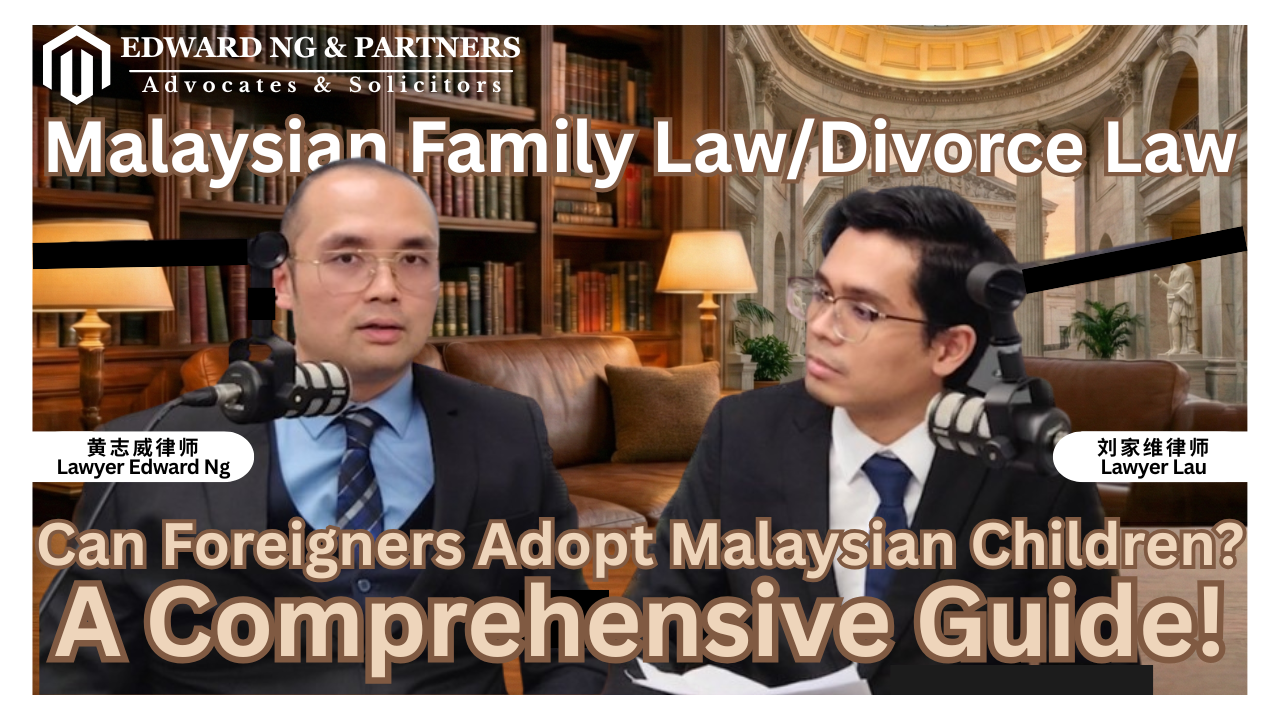
How Can Foreigners Adopt a Child in Malaysia ? A Complete Step-by-Step Guide !

How Can Foreigners Adopt a Child in Malaysia ? A Complete Step-by-Step Guide !

This Episode Discusses a More “Cross-Border” Issue: Can Foreigners Adopt Malaysian Children in Malaysia? What Procedures and Key Considerations Are Involved if the Child Is Later Taken Abroad? 1) First Clarify: What Is Meant by “Foreign Adoption”? It can generally be divided into two situations: (A) One spouse is a…
What If the Other Party Converts to Islam During the Tribunal Exemption Process?

What If the Other Party Converts to Islam During the Tribunal Exemption Process?

In matrimonial matters, a common question arises: if one party is in the process of applying for a “tribunal exemption,” and the other party suddenly converts to Islam, will this affect the divorce proceedings? First, it depends on the stage of the process. If the exemption application has just begun…
If You Have Already Gone to Court for Child Custody, Can You Skip JPN in Divorce Proceedings?Part 2

If You Have Already Gone to Court for Child Custody, Can You Skip JPN in Divorce Proceedings?Part 2

Many people attempt to link “custody orders” with “divorce proceedings,” assuming that if both parties are already complying with a custody order, the divorce process should become simpler, or even qualify for procedural exemptions. However, in essence, these remain separate matters. If both parties comply with the custody order—maintenance is…
If You Have Already Gone to Court for Child Custody, Can You Skip JPN in Divorce Proceedings?Part 1

If You Have Already Gone to Court for Child Custody, Can You Skip JPN in Divorce Proceedings?Part 1

In handling family matters, many people tend to confuse “child custody” with “divorce.” However, in law, these are entirely separate procedures. Some parents, even before divorce, have already applied for and obtained a court order regarding child custody. Such orders may include guardianship, visitation rights, and even maintenance (child support)…
If One Party Is Living Overseas and Not Returning to Malaysia, Can This Be a Ground for Divorce?

If One Party Is Living Overseas and Not Returning to Malaysia, Can This Be a Ground for Divorce?

Can a Partner Living Overseas for a Long Period Constitute a “Special Circumstance”? There are indeed such situations: The other party has been living abroad for many years It is confirmed that the person is in a certain country It is even known that the person holds residency rights in…
Does the Other Party’s Imprisonment Affect Divorce?

Does the Other Party’s Imprisonment Affect Divorce?

In legal proceedings, certain situations may allow exemption from mediation or special procedural treatment, one of which is the other party being in prison. However, not all imprisonment cases qualify, as the law sets clear conditions. Imprisonment as a “Special Circumstance” Condition The law generally stipulates: imprisonment of five years…
Special Circumstances in Divorce: Do Domestic Violence or Emotional Abuse Count? Uncovering the Grey Areas!Part 2

Special Circumstances in Divorce: Do Domestic Violence or Emotional Abuse Count? Uncovering the Grey Areas!Part 2

In legal proceedings, domestic violence does not only refer to physical harm; psychological abuse may also be regarded as a “special circumstance.” However, the key issue in law is evidence. Can Psychological Abuse Be Considered a “Special Circumstance”? In principle: yes, because psychological abuse can also cause serious stress, anxiety,…
Special Circumstances in Divorce: Do Domestic Violence or Emotional Abuse Count? Uncovering the Grey Areas!Part 1

Special Circumstances in Divorce: Do Domestic Violence or Emotional Abuse Count? Uncovering the Grey Areas!Part 1

What is a “Special Circumstance”? The law does not provide a complete list specifying which situations are definitively considered “special circumstances” It is a broad and undefined concept Judges exercise discretionary power based on the facts of each individual case The key issue is whether there are sufficient reasons to…
Does Divorce Require Court Approval? Key Factors You Must Know!

Does Divorce Require Court Approval? Key Factors You Must Know!

When applying to the court for exemption from mediation, valid and sufficient reasons must be provided—especially when the law ordinarily requires mediation first. “Special circumstances” is a broad legal concept, assessed based on the facts of each case. The law provides some clearer examples: The other party is serving a…

Is Your Divorce Being Delayed by the Other Party? What If They Don’t Attend JPN?

Is Your Divorce Being Delayed by the Other Party? What If They Don’t Attend JPN?

Many people worry: If the other party refuses to attend mediation, does that mean divorce becomes impossible? The answer is: No. If you initiate mediation and the other party repeatedly fails to attend, the relevant authority will issue a Sijil confirming their absence. This document is crucial because it can…
Divorce Mediation: Does Going Three Consecutive Days Count as Three Visits? Is This Allowed?

Divorce Mediation: Does Going Three Consecutive Days Count as Three Visits? Is This Allowed?

Many people further ask: “How are the three sessions counted? Is it once per month? Can it be completed in three consecutive days?” There is often misunderstanding about this. These sessions are not freely scheduled nor designed to be completed in a short period. They are not merely procedural steps…
Do You Really Need to Go to JPN Three Times for Divorce? This Might Be Simpler!Part 2

Do You Really Need to Go to JPN Three Times for Divorce? This Might Be Simpler!Part 2

Many people ask: “Do I have to attend JPN three times before I can proceed with a unilateral divorce?” The answer is: not necessarily. There is a common belief that three visits are mandatory, but in practice, not every case follows the same pattern. Is Three Attendance Sessions Mandatory? In…

error: Content is protected !!
Welcome to Edward Ng & Partners! Click to consult with our lawyer! 欢迎来到爱德华·黄律师事务所,点击联系我们的律师
//
Lawyer Edward Ng 黄志威律师 황지위 변호사
Divorce, Child Adoption, Will, Probate & LA, CIPAA, Civil & Corporate Litigation, Debt Recovery, Defamation, Tax Law.
Consult Lawyer 咨询律师 상담문의