

Malaysian Family Law/Divorce Law |
Do I really have to attend mediation at JPN three times before I can get a divorce?! Can I apply to the court for an exemption?

Malaysian Family Law/Divorce Law | Do I really have to attend mediation at JPN three times before I can get a divorce?! Can I apply to the court for an exemption?

Recently, we have received many enquiries concerning the “Marriage Tribunal / reconciliation process at JPN” and the possibility of applying for an exemption. Many people, when they first consider divorce, worry that the procedure is complicated, and some have even been told that “to get divorced, you must attend JPN at least three times.” In truth, that understanding is not entirely accurate. This article sets out the key points clearly: when must you attend JPN, what does an “exemption” mean, and how should the matter be dealt with.


1. Is attendance at JPN mandatory for every divorce?

Not necessarily.

Where both parties agree to divorce (and have reached agreement on the terms), the general process is:

  • both parties negotiate and agree on the divorce terms (which must be lawful);

  • the terms are reduced into writing, signed, and affirmed;

  • the documents are filed in Court;

  • both parties attend Court on the hearing date; and

  • the Judge grants the divorce in accordance with the agreed terms.

In such circumstances, there is generally no requirement to undergo the JPN reconciliation process.

Attendance at JPN typically arises where:

  • the divorce is unilateral (i.e., one party does not agree to divorce or the parties cannot reach agreement on the terms);
    In such cases, the matter usually proceeds through the JPN reconciliation process.


2. Must one “go to JPN three times” as a fixed rule?

Not necessarily.

In practice, some matters do not require three full sessions. For example:

  • the applicant may attend the first session alone;

  • the other party may still fail to attend the second session; and

  • JPN may, in some instances, issue the relevant certificate (Sijil) at the second session;

  • the applicant may then use that certificate to take the next procedural step (for example, to seek an exemption and/or to proceed with the Court process).

That said, there are also cases where the matter reaches a third session because the other party repeatedly fails to attend. The key point is that it is not correct to treat “three sessions” as an absolute and inflexible requirement in every case.


3. Can the three sessions be “completed” consecutively (e.g., three days in a row)?

No.

This is because the process at JPN is intended for reconciliation/mediation, not for merely “completing a procedure.” The process is designed to provide time and opportunity for discussion, reflection, and the possibility of reconciliation. The statutory purpose is to encourage the parties to engage and attempt resolution, rather than to allow an expedited “check-the-box” completion.


4. What if the other party deliberately refuses to attend? Does that prevent the divorce?

It should not.

If the other party fails to attend, the applicant may obtain a certificate confirming the non-attendance. This certificate can then be relied upon to progress the matter, including:

  • as a basis to seek exemption from the reconciliation process (where applicable); and/or

  • to proceed to the next stage of a unilateral divorce.

The essential point is: the other party’s refusal to attend does not necessarily mean the applicant is indefinitely prevented from moving forward.


5. What is an “exemption”? Exemption from what?

In this context, an “exemption” generally refers to an application to be exempted from attending and/or continuing the JPN reconciliation process, such that the party may proceed more directly with the Court process (including a unilateral divorce, where applicable).

Some parties attend JPN first, and if the other party does not appear, they obtain a certificate and then apply for an exemption. Others wish, from the outset, to avoid attending JPN entirely and apply directly to Court for exemption (subject to the Court’s approval).


6. On what grounds will the Court typically grant an exemption?

Generally, the applicant must demonstrate special circumstances. The scope of “special circumstances” can be broad and is often assessed case-by-case, with the Court exercising its discretion. Common examples (including those expressly contemplated in legislation and/or frequently encountered in practice) include:

  • the other party has been sentenced to imprisonment of five (5) years or more;

  • the other party suffers from mental illness (supported by medical and/or institutional evidence);

  • the other party is missing and cannot be located (supported by evidence of genuine and substantial efforts to locate them);

  • the other party has been abroad for a prolonged period and is unable to return within a reasonable time, making reconciliation impracticable.

Where the ground is that the other party cannot be found, it is often necessary to show that the applicant has taken best efforts to locate them, including (where relevant):

  • attempts to contact them (e.g., call logs, WhatsApp records);

  • visits to the last known address and/or relatives’ residences;

  • enquiries made with family members who are unable to confirm the person’s whereabouts;

  • publication/notice efforts (where appropriate); and

  • a police report, which is strongly advisable as it supports the credibility of the assertion that the person cannot be located.


7. Does domestic violence or psychological abuse amount to “special circumstances”?

Generally, it may, but the crucial issue is evidence.

If physical domestic violence is alleged, relevant evidence may include:

  • police reports;

  • applications to the appropriate authorities for protection and related orders;

  • medical reports;

  • photographs and contemporaneous documentation.

If psychological or emotional abuse is alleged, the Court will still typically expect objective support, such as:

  • messages, recordings, or communications evidencing harassment, threats, or sustained abusive conduct; and/or

  • reports or documentation, depending on the nature of the case.

The Court ordinarily must be satisfied that the circumstances are genuine and sufficiently serious, and that they are supported by credible material, rather than being bare assertions.


8. What if the other party converts to Islam during the process—does that affect exemption?

If the other party has converted, it may no longer be necessary to pursue an exemption through the reconciliation process. In many cases, the conversion itself may constitute a basis to proceed directly with a unilateral divorce application.

Further, where the marriage was registered under civil law, proceedings are generally commenced in the civil court (the Family Court) notwithstanding the other party’s conversion, and the Court retains jurisdiction to determine ancillary matters such as children and matrimonial assets.


9. Does obtaining an exemption order mean the parties are already divorced?

No.

An exemption order generally means that the applicant is permitted to bypass and/or discontinue the reconciliation process and proceed with the Court process. In Malaysia, the dissolution of a civil marriage ultimately requires a Court order granting the divorce.

A common misconception is that because marriage registration can be done through a government department, divorce can likewise be completed through a government department. In Malaysia, however, the marriage is dissolved only when the Court grants the divorce.


10. If one intends to engage a lawyer, what should be prepared?

The practical starting point is not to guess what documents are needed, but to:

  • provide the lawyer with sufficient information to understand your circumstances (the relevant divorce route, the other party’s status and conduct, the intended grounds for exemption, and what evidence is already available).

This is because no two cases are identical, and the required documents and strategy will depend on the facts of each case.

Legal Podcasts

After Divorce, Can I Still Claim Maintenance from My Ex Husband? Full Guide to Maintenance & Property Division!

After Divorce, Can I Still Claim Maintenance from My Ex Husband? Full Guide to Maintenance & Property Division!

I. If maintenance was paid before the divorce, can it continue after the divorce? Where, during the subsistence of the marriage, the husband had consistently and regularly provided the wife with maintenance (for example, by monthly bank transfers), the wife may, upon divorce, apply to the Court for continuing maintenance.…
Husband refuses to pay maintenance? Can I still claim maintenance without a divorce?

Husband refuses to pay maintenance? Can I still claim maintenance without a divorce?

I. What can a wife do if her husband refuses to provide maintenance during the marriage? In Malaysia, a wife may apply to the Court under the Married Women and Children (Maintenance) Act 1950 to claim: maintenance for herself; and maintenance for the child(ren), including maintenance for illegitimate child(ren).The wife…

Is Adultery Hard to Prove? Can I Hire a Private Investigator to Track Them?

Is Adultery Hard to Prove? Can I Hire a Private Investigator to Track Them?

I. What amounts to “adultery”? Put simply, adultery refers to consensual sexual intercourse between two persons, where at least one party is married and the marriage is still subsisting. The key elements are: A voluntary sexual relationship; and One party is in an existing marriage. Because sexual intercourse is rarely…

Malaysian Family Law/Divorce Law | Break the Silence on Domestic! A complete guide to Malaysia’s Domestic Violence Protection Orders!

Malaysian Family Law/Divorce Law | Break the Silence on Domestic! A complete guide to Malaysia’s Domestic Violence Protection Orders!

Domestic Violence Is Not Limited to Physical Assault: Two Key Categories Generally, domestic violence may be understood in two broad categories: Physical violence: including acts such as assault, pushing, or causing bodily injury. Psychological or emotional abuse: including persistent humiliation, threats, verbal abuse, coercion, intimidation, and what is commonly described…

Malaysian Family Law/Divorce Law | Do I really have to attend mediation at JPN three times before I can get a divorce?! Can I apply to the court for an exemption?

Malaysian Family Law/Divorce Law | Do I really have to attend mediation at JPN three times before I can get a divorce?! Can I apply to the court for an exemption?

1. Is attendance at JPN mandatory for every divorce? Not necessarily. Where both parties agree to divorce (and have reached agreement on the terms), the general process is: both parties negotiate and agree on the divorce terms (which must be lawful);the terms are reduced into writing, signed, and affirmed; the…
Malaysian Family Law/Divorce Law | Can Foreigners Adopt Malaysian Children? A Comprehensive Guide!

Malaysian Family Law/Divorce Law | Can Foreigners Adopt Malaysian Children? A Comprehensive Guide!

1. Definition: “Foreigner Adoption ”Generally, this may be understood in two situations:(A) One spouse is a foreigner and the other is a Malaysian citizen. This is commonly not treated as a “foreign adoption” in the strict sense, because the family is ordinarily residing in Malaysia. In such circumstances, the adoption…
Malaysian Family Law/Divorce Law | Stop him from marrying the mistress? Claim his assets & claim for maintenance? Is that possible?

Malaysian Family Law/Divorce Law | Stop him from marrying the mistress? Claim his assets & claim for maintenance? Is that possible?

When people hear “divorce lawyers” or “family law”, the first impression is often that we only handle divorces. In reality, many family law applications do not necessarily require a divorce. Today’s topic is an option that is closely related to divorce procedures but is not a divorce—Judicial Separation.

Can I obtain a court order to restrain my spouse from taking the child overseas?

Can I obtain a court order to restrain my spouse from taking the child overseas?

Many people hear the word “injunction” and immediately think of frozen bank accounts, travel bans, or asset freezes. Here, the focus is different. This is about injunctions involving children—specifically, controlling or preventing a child being taken out of Malaysia.In practice, child-related injunctions commonly fall into two directions:Permission for the child…
TOP 12 Malaysia Child Adoption Law FAQs

TOP 12 Malaysia Child Adoption Law FAQs

In Malaysia, adoption is not something you can do simply because you want to. It is a legal process centred on “the best interests of the child.” For non-Muslims, there are generally two common adoption routes: court adoption (through the courts) and the National Registration Department (JPN) adoption process. The…
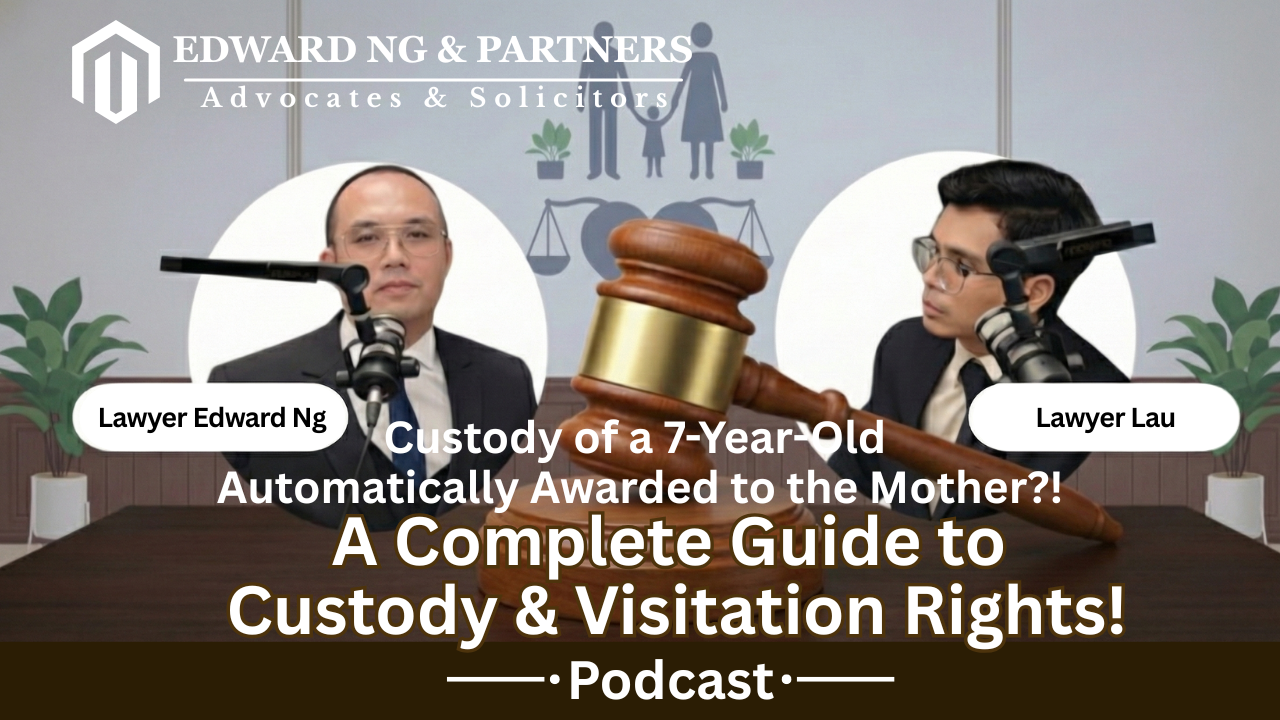
Custody of a 7-Year-Old Automatically Awarded to the Mother?! | A Complete Guide to Custody & Visitation Rights!

Custody of a 7-Year-Old Automatically Awarded to the Mother?! | A Complete Guide to Custody & Visitation Rights!

Many people hear the term “child custody” and immediately think of divorce. But in real life, custody issues are often more urgent and need to be dealt with first, especially when the parents’ relationship has already broken down, or they have been separated for a long time, and one parent…

error: Content is protected !!
Welcome to Edward Ng & Partners! Click to consult with our lawyer! 欢迎来到爱德华·黄律师事务所,点击联系我们的律师
//
Lawyer Edward Ng 黄志威律师 황지위 변호사
Divorce, Child Adoption, Will, Probate & LA, CIPAA, Civil & Corporate Litigation, Debt Recovery, Defamation, Tax Law.
Consult Lawyer 咨询律师 상담문의