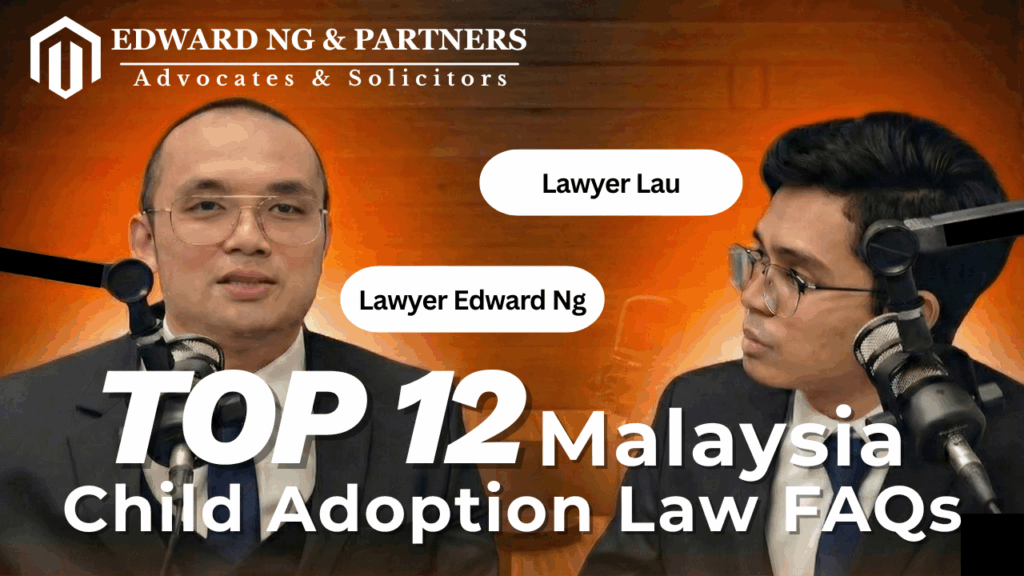

TOP 12 Malaysia Child Adoption Law FAQs

TOP 12 Malaysia Child Adoption Law FAQs

In Malaysia, adoption is not something you can do simply because you want to. It is a legal process centred on “the best interests of the child.” For non-Muslims, there are generally two common adoption routes: court adoption (through the courts) and the National Registration Department (JPN) adoption process. The two routes differ clearly in terms of time, conditions, and the resulting documents.


1. Two Routes for Non-Muslim Adoption


1) Court Adoption (Through the Courts)

Many people tend to choose court adoption, usually because:

  • It is relatively faster (in practice, commonly about six months)

  • Many people do not like handling matters at government departments themselves and find it troublesome, so they prefer to go through court procedures


2) JPN Adoption

The other route is the JPN process. Overall, this route generally requires a longer care period and takes more time.


2. Adopter Eligibility: The Age Threshold Is Key

In practical understanding, an adoption applicant usually needs to:

  • Be at least 25 years old

  • Be at least 21 years older than the child

This means that if an applicant is too young, even if they have sufficient financial ability, they may still be more strictly scrutinised during the assessment.


3. Gender and Marital Status: Restrictions for Unmarried Men Adopting a Girl

The subtitles mention: if the adopter is an unmarried man, adopting a girl may, in practice and as understood, not be allowed; adopting a boy is usually not a problem.

At the same time, it should be understood that adoption is not only about “meeting the requirements.” The applicant’s motives and long-term care arrangements may also be questioned, especially when the applicant is very young, and such issues can be more sensitive.


4. Welfare Department Assessment Report: Key, but Generally Not Shown to Applicants

Even if one proceeds with court adoption, a Welfare Department officer will still participate and prepare a report to be submitted to the court. The report assesses whether the applicant is suitable to adopt from many aspects, including but not limited to:

  • Financial situation

  • Living environment

  • Education and employment situation (and whether there may be relocation/transfer in the future)

  • Family background

  • Whether the applicant already has children or has previously adopted

  • Overall suitability assessment

  • Whether the applicant supports the adoption and the reasons

This report is primarily for the court’s discretion, not for applicants to “preview the questions in advance.”


5. How Does the Court Decide? The Core Principle Is the Best Interests of the Child

The court and the Welfare Department generally share the same direction of consideration: guiding everything by the best interests of the child. After reviewing the Welfare Department report, the judge decides whether to approve the adoption.


6. How Long Does It Take? Commonly About Six Months, but It Varies by Case

The subtitles mention: the overall process is commonly about six months.
One reason is that the Welfare Department officer needs time to prepare the report (usually about three months).

If the case has urgent reasons (for example, needing to handle overseas arrangements after the adoption), an application may be made to the judge to shorten the preparation period. However, it still depends on the Welfare Department officer’s workload and whether they agree, as well as the court schedule. Therefore, there is no fixed “formula.”


7. Adoption Cases Are Usually Heard In Chambers: Greater Focus on Privacy

The subtitles also mention: adoption procedures are mostly conducted in chambers (not open to the public) to protect privacy. In rare situations, they may be heard in open court, but this is not common.


8. Getting the Court Order Is Not the End: You Still Need to Go to JPN to Change the New Birth Certificate

Court procedures usually involve two court attendances:

  • First: the court appoints a Welfare Department officer to prepare the report

  • Second: the officer submits the report; if the judge agrees, the adoption may be approved and a court order issued

However, after obtaining the court order, you still need to submit the court order and the child’s original birth certificate to the department at JPN Headquarters that handles adoption matters, to process the issuance of a new birth certificate. Only when the new birth certificate is completed is the process truly and fully concluded.


9. Will the Adoption Documents Be “Obvious at a Glance”? The Two Routes Differ

  • Court adoption: the new birth certificate looks very similar to a normal birth certificate, with only slight differences; only those who often look at them can more easily identify it

  • JPN process: because it takes longer (for example, requiring two years of care), the form of the documents issued will more clearly show that they are adoption-related documents


10. After Adoption, Is There Any Legal Difference Compared to a Biological Child?

The conclusion in the subtitles is: generally, no. After the adoption is completed, the child will, in legal terms, be regarded as the lawful child of the adoptive parents, including legal treatment such as inheritance.


11. Why Does the JPN Process Still Exist?

The subtitles mention: non-Muslims can choose either court or JPN; however, certain groups, under the system, can only go through JPN and cannot go through the courts. Therefore, the JPN process still has a necessary role to play.


12. Can an Adopted Child Be Adopted Again?

The subtitles mention: in specific circumstances, it may be possible. This includes applying to the court to discharge the adoption, or having a new family apply to adopt a child who has been adopted before. However, such cases will be scrutinised more strictly. Welfare Department officers will also question the reasons, and may even need to retrieve the previous report, making the process more complex.


Final Reminder

Adoption is not only about completing a procedure; it is a long-term commitment. Once you decide to adopt, regardless of the child’s condition, you should treat them well, cherish them, and raise them properly, treating the child as your own.

Legal Podcasts

After Divorce, Can I Still Claim Maintenance from My Ex Husband? Full Guide to Maintenance & Property Division!

After Divorce, Can I Still Claim Maintenance from My Ex Husband? Full Guide to Maintenance & Property Division!

I. If maintenance was paid before the divorce, can it continue after the divorce? Where, during the subsistence of the marriage, the husband had consistently and regularly provided the wife with maintenance (for example, by monthly bank transfers), the wife may, upon divorce, apply to the Court for continuing maintenance.…

Husband refuses to pay maintenance? Can I still claim maintenance without a divorce?

Husband refuses to pay maintenance? Can I still claim maintenance without a divorce?

I. What can a wife do if her husband refuses to provide maintenance during the marriage? In Malaysia, a wife may apply to the Court under the Married Women and Children (Maintenance) Act 1950 to claim: maintenance for herself; and maintenance for the child(ren), including maintenance for illegitimate child(ren).The wife…

Is Adultery Hard to Prove? Can I Hire a Private Investigator to Track Them?

Is Adultery Hard to Prove? Can I Hire a Private Investigator to Track Them?

I. What amounts to “adultery”? Put simply, adultery refers to consensual sexual intercourse between two persons, where at least one party is married and the marriage is still subsisting. The key elements are: A voluntary sexual relationship; and One party is in an existing marriage. Because sexual intercourse is rarely…

Malaysian Family Law/Divorce Law | Break the Silence on Domestic! A complete guide to Malaysia’s Domestic Violence Protection Orders!

Malaysian Family Law/Divorce Law | Break the Silence on Domestic! A complete guide to Malaysia’s Domestic Violence Protection Orders!

Domestic Violence Is Not Limited to Physical Assault: Two Key Categories Generally, domestic violence may be understood in two broad categories: Physical violence: including acts such as assault, pushing, or causing bodily injury. Psychological or emotional abuse: including persistent humiliation, threats, verbal abuse, coercion, intimidation, and what is commonly described…

Malaysian Family Law/Divorce Law | Do I really have to attend mediation at JPN three times before I can get a divorce?! Can I apply to the court for an exemption?

Malaysian Family Law/Divorce Law | Do I really have to attend mediation at JPN three times before I can get a divorce?! Can I apply to the court for an exemption?

1. Is attendance at JPN mandatory for every divorce? Not necessarily. Where both parties agree to divorce (and have reached agreement on the terms), the general process is: both parties negotiate and agree on the divorce terms (which must be lawful);the terms are reduced into writing, signed, and affirmed; the…
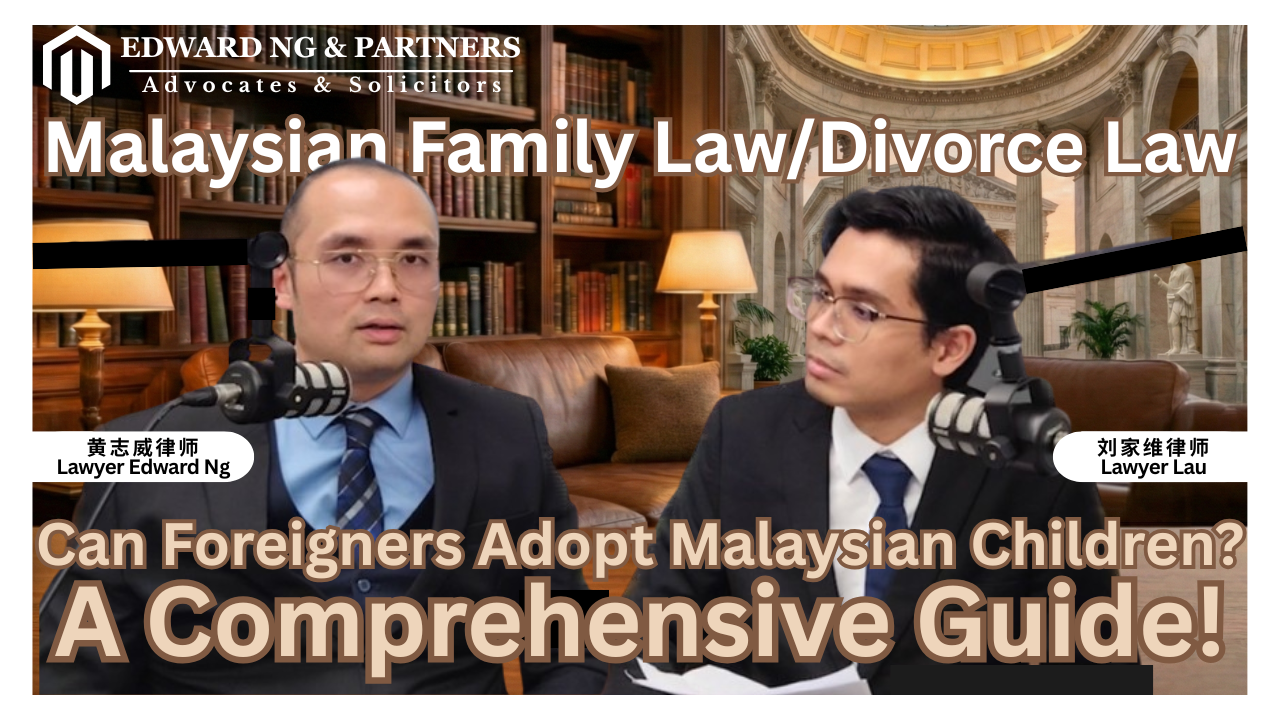
Malaysian Family Law/Divorce Law | Can Foreigners Adopt Malaysian Children? A Comprehensive Guide!

Malaysian Family Law/Divorce Law | Can Foreigners Adopt Malaysian Children? A Comprehensive Guide!

1. Definition: “Foreigner Adoption ”Generally, this may be understood in two situations:(A) One spouse is a foreigner and the other is a Malaysian citizen. This is commonly not treated as a “foreign adoption” in the strict sense, because the family is ordinarily residing in Malaysia. In such circumstances, the adoption…
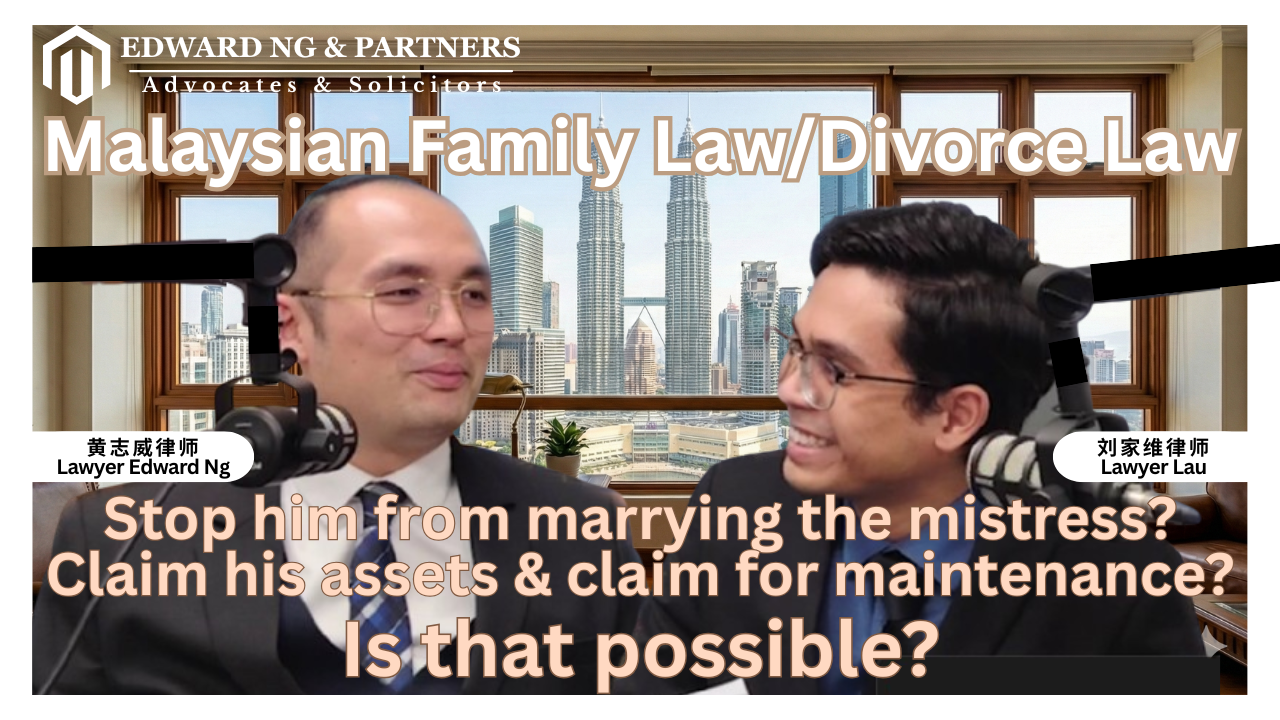
Malaysian Family Law/Divorce Law | Stop him from marrying the mistress? Claim his assets & claim for maintenance? Is that possible?

Malaysian Family Law/Divorce Law | Stop him from marrying the mistress? Claim his assets & claim for maintenance? Is that possible?

When people hear “divorce lawyers” or “family law”, the first impression is often that we only handle divorces. In reality, many family law applications do not necessarily require a divorce. Today’s topic is an option that is closely related to divorce procedures but is not a divorce—Judicial Separation.
Can I obtain a court order to restrain my spouse from taking the child overseas?

Can I obtain a court order to restrain my spouse from taking the child overseas?

Many people hear the word “injunction” and immediately think of frozen bank accounts, travel bans, or asset freezes. Here, the focus is different. This is about injunctions involving children—specifically, controlling or preventing a child being taken out of Malaysia.In practice, child-related injunctions commonly fall into two directions:Permission for the child…
TOP 12 Malaysia Child Adoption Law FAQs

TOP 12 Malaysia Child Adoption Law FAQs

In Malaysia, adoption is not something you can do simply because you want to. It is a legal process centred on “the best interests of the child.” For non-Muslims, there are generally two common adoption routes: court adoption (through the courts) and the National Registration Department (JPN) adoption process. The…
Custody of a 7-Year-Old Automatically Awarded to the Mother?! | A Complete Guide to Custody & Visitation Rights!

Custody of a 7-Year-Old Automatically Awarded to the Mother?! | A Complete Guide to Custody & Visitation Rights!

Many people hear the term “child custody” and immediately think of divorce. But in real life, custody issues are often more urgent and need to be dealt with first, especially when the parents’ relationship has already broken down, or they have been separated for a long time, and one parent…

error: Content is protected !!
Welcome to Edward Ng & Partners! Click to consult with our lawyer! 欢迎来到爱德华·黄律师事务所,点击联系我们的律师
//
Lawyer Edward Ng 黄志威律师 황지위 변호사
Divorce, Child Adoption, Will, Probate & LA, CIPAA, Civil & Corporate Litigation, Debt Recovery, Defamation, Tax Law.
Consult Lawyer 咨询律师 상담문의