

Malaysia TOP 100 Divorce Law FAQ
Award-Winning Family Law Firm in Malaysia

Edward Ng & Partners is proud to be recognized for its excellence in legal services and commitment to delivering outstanding results for clients. Our firm has been nominated as the top Finalist at the ALB Malaysia Law Awards 2026 and ALB SE Asia Law Awards 2026 in the category of “Matrimonial and Family Law Firm of the Year”. 

I. Common Misconceptions About Joint Petition Divorce
(Mutual Consent Divorce)

Q1: Is it necessary to attend court to apply for divorce, or is signing at a law firm sufficient?

After signing the documents at the law firm, both parties are still required to attend court.

Q2: If I do not wish to see the other party but want a divorce, is it possible?

You may attend the law firm on different dates to sign the divorce consent documents, but both parties must still be present together in court.

Q3: Can we agree to divorce first and decide on the terms (e.g. child custody, maintenance) later?

No. All terms must be decided at the time of filing the divorce application.

Q4: If both parties jointly own a property and one party no longer wishes to service the mortgage after divorce, is that allowed?

Both parties must reach an agreement on who will service the mortgage prior to the divorce.

Q5: My husband has an affair but I have no evidence. Can I still apply for divorce?

Yes. Mutual consent divorce does not require proof of adultery.

Q6: Must we attend mediation before applying for divorce?

No. Mediation is not required for mutual consent divorce.

Q7: What documents must I provide to the lawyer?

Marriage certificate (copy), children’s birth certificates (if any), property documents (if relevant), and bank account details (if maintenance is involved), among others.

Q8: What grounds are required for mutual consent divorce?

It is sufficient to state that the marriage has irretrievably broken down. No specific reason is required.

Q9: How long does a divorce take to become effective?

Generally about 3 months, though an application may be made for immediate effect.

Q10: Do both parties need to meet the lawyer?

Yes. Both parties must provide information and sign the documents before a Commissioner for Oaths.

Q11: Must children attend court?

Generally no, unless specifically required by the court.

Q12: If one party cannot attend court, can the divorce still proceed?

Yes. The lawyer may apply for exemption, and documents can be signed before a Commissioner for Oaths.

Q13: If the hearing date clashes with travel plans, can the case proceed?

An adjournment may be requested, or the hearing may be conducted via Zoom.

Q14: If one party is a foreigner who does not understand Malay, can divorce still proceed?

Yes. An interpreter will translate the documents before signing.

Q15: Can we proceed without informing the children?

Yes. Children need not be informed in a mutual consent divorce.

Q16: Can we continue living together after divorce?

Yes.

Q17: Can maintenance be adjusted after divorce if already agreed?

No. Any adjustment requires a court application to vary the order.

Q18: Can property division be changed after divorce?

No. Once the court order is final, it cannot be altered.

Q19: Can I claim a share of property acquired by my ex-spouse after divorce?

No.

Q20: Can I continue receiving maintenance after remarriage?

No, pursuant to Section 82 of the Law Reform (Marriage & Divorce) Act 1976.

Q21: Can I still receive maintenance if I cohabit with other partner after divorce?

Generally, yes.

Q22: Do both parties need to engage lawyers?

No. One party engaging a lawyer is sufficient.

Q23: What if one party refuses to negotiate terms?

It is advisable to reach agreement first; otherwise, mutual consent divorce may not be suitable.

Q24: Do I need to update my status with JPN after divorce?

No. The court will update it automatically.

Q25: Can maintenance still be claimed for a child above 18?

Yes, if the child is still pursuing education, and it can be claimed until graduation.

Q26: Can we apply for mutual divorce if married less than two years?

No. The marriage must be at least two years. Unless exception apply.

Q27: What if I fail to pay maintenance?

The other party may file a committal application for non-compliance with a court order.

Q28: What if I do not understand Malay in the divorce documents?

A translator will be arranged before signing the affidavit.

Q29: What happens in court? Will the judge ask complex questions?

Usually not. The judge will normally just confirm both party understanding and consent.

Q30–Q32: Divorce Within Two Years of Marriage

Mutual consent divorce is generally not allowed;
Divorce may be possible under special circumstances or hardship;
Mediation may be attempted but no certificate will be issued if it fails.

II. Unilateral Divorce (Without Mutual Consent)

Q33: What if I want a divorce but my spouse refuses?

You may file a unilateral divorce petition. (Single Petition Divorce)

Q34: What must be done before filing?

You must first attempt reconciliation at a Conciliatory Body.

Q35: What is a Conciliatory Body?

As defined under Section 106(3): religious bodies, associations, tribunals, or government-recognised bodies.

Q36: Is reconciliation mandatory?

Not necessarily; exemption may be applied through a lawyer.

Q37: Can a lawyer assist in avoiding reconciliation?

Yes, by applying for exemption.

Q38: What are valid grounds for exemption?

Includes desertion, unknown whereabouts, overseas residence, imprisonment, mental illness, or special circumstances.

Q39: How many sessions are required?

At least 3 sessions; duration varies.

Q40: What happens during reconciliation?

Both parties present their views; if unsuccessful, a certificate is issued with recommendations.

Q41: Can divorce be filed after obtaining the certificate?

Yes.

Q42: What if the other party refuses to attend?

A certificate may still be issued indicating failure to reconcile for the session.

Q43: Must we be separated for two years before filing?

No. Proof of breakdown is sufficient.

Q44: If adultery is involved, must we still wait two years?

No, but proof of adultery is required.

Q45: Can I sue the third party?

Yes, under Section 58(3).

Q46: What can be claimed?

Typically damages, subject to court decision.

Q47: Is evidence required?

Yes, to a high standard of proof.

Q48: What evidence proves adultery?

Circumstantial evidence, birth records, medical evidence, or admission.

Q49: Adultery after separation—can I sue?

Yes, but not as grounds for divorce.

Q50: No direct proof but a child exists?

Possible, if the birth certificate identifies the husband.

Q51: Outcome of suing third party?

Compensation if successful; costs if unsuccessful.

Q52: Other grounds for divorce?

Unreasonable behaviour, desertion, or separation.

Q53: What is unreasonable behaviour?

Neglect, control, jealousy, or abuse.

Q54: How to prove desertion?

Communication records showing no contact for two years.

Q55: Alternatives if divorce is not possible?

Apply for judicial separation.

Q56: Requirements for judicial separation?

Marriage in Malaysia, monogamous, residency, and breakdown grounds.

Q57: If spouse is overseas?

Application still possible under certain conditions.

Q58: Grounds for judicial separation?

Adultery, behaviour, desertion, or separation.

Q59: Effects of judicial separation?

Marriage continues, no remarriage, no cohabitation obligation.

Q60: If spouse cannot consummate marriage?

Apply for nullity of marriage.

Q61: Effect on children?

Children remain legitimate.

III. Maintenance (Spousal Support)

Q62: What is maintenance?

Financial support covering living expenses, housing, medical, and transport.

Q63: Types of maintenance?

Periodic or lump sum.

Q64: Can it be lump sum?

Yes, for a “clean break”.

Q65: When can maintenance be claimed?

During proceedings or upon court orders.

Q66: What if unable to support oneself before trial?

Apply for interim maintenance.

Q67: Can maintenance be adjusted after divorce?

Yes.

Q68: What factors are considered?

Marriage duration, children, age, income, and financial impact.

Q69: Can a husband claim maintenance?

Yes.

IV. Child Maintenance & Rights

Q70: What does child maintenance cover?

Living, housing, medical, transport, and education.

Q71: Until when is it payable?

18 years old, or longer if studying or special needs.

Q72: When can court order child maintenance?

During disputes, abandonment, or custody arrangements.

Q73: Must the father pay?

Usually, unless the mother is capable.

Q74: What factors are considered?

Parents’ financial ability.

Q75: Other legal basis?

Married Women and Children (Maintenance) Act 1950.

Q76: Can it be adjusted?

Yes.

Q77: Does it include university fees?

Yes.

Q78: Legally extension for payment of maintenance?

Yes, able to extend until university completion since 2018.

Q79: Are receipts required?

Generally yes.

Q80: If payment is refused?

Legal enforcement; contempt may lead to imprisonment.

V. Property Division & Real Estate

Q81: If spouse secretly disposes property?

Apply for injunction.

Q82: Court considerations?

Nature of asset, contributions, and other factors.

Q83: Is division always equal?

No.

Q84–Q87: Property entitlement scenarios

Depends on contributions and court’s assessment.

Q88: Can property be left to children?

Yes, subject to conditions.

Q89: For minors?

Held in trust until 18 years old.

Q90: If spouse refuses transfer?

Court may sign on behalf; caveat may be lodged on the property.

Q91: If spouse refuses to pay mortgage?

Legal action may be taken.

Q92: Sale of jointly owned property?

Court may intervene if one party refuses to cooperate.

Q93: Prevent future disputes?

Settle mortgage early.

Q94: When can orders be varied?

Misrepresentation, mistake, or material change.

VI. Child Custody

Q95: Can custody be applied before divorce?

Yes.

Q96: Is custody always given to mother (under 7 years old)?

Usually, but not absolute.

Q97: Can third-party reports be required?

Yes.

Q98: Will child’s wishes be considered?

Yes, subject to maturity.

Q99: Multiple children?

Court prefers keeping siblings together to one party.

Q100: Can additional conditions be imposed?

Yes, including residence, education, visitation, and travel restrictions.


Legal Articles

If You Appoint Amanah Raya as a Temporary Estate Administrator, Will the Fees Be Lower?

If You Appoint Amanah Raya as a Temporary Estate Administrator, Will the Fees Be Lower?

In many estate disputes, what causes the process to stall is not “how to divide the estate”, but “who should manage it”. When family members do not trust each other or cannot reach agreement, and multiple parties insist on being appointed, the court may, in certain circumstances, prefer appointing a…
What to do if siblings can't agree on the division of inheritance?

What to do if siblings can't agree on the division of inheritance?

In estate administration cases, one of the most common and conflict-prone issues is: who should be responsible for managing the estate. This becomes especially sensitive when the deceased left behind substantial assets such as multiple properties, bank savings, investments, or other forms of wealth. In such situations, it is not…
Siblings Disputing Over Estate Administrator? What Factors Does the Court Usually Consider?

Siblings Disputing Over Estate Administrator? What Factors Does the Court Usually Consider?

This Episode: Who Should Be the Administrator of an Estate? How Does the Court Decide? In this episode, we discuss an issue that many families encounter, but which often escalates into court disputes: who should be appointed as the Administrator of an estate, and what factors does the court consider?…
In Malaysian Law, If the Other Party Has No Evidence = Do I Automatically Win?Part 2

In Malaysian Law, If the Other Party Has No Evidence = Do I Automatically Win?Part 2

Many people ask: if the opposing party allegedly has evidence but chooses not to produce it in court, is there any legal principle addressing this situation in Malaysia? It must be stated carefully: This does not mean that failure to produce evidence automatically benefits one party or harms the other.…
In Malaysian Law, If the Other Party Has No Evidence = Do I Automatically Win? Part 1

In Malaysian Law, If the Other Party Has No Evidence = Do I Automatically Win? Part 1

To make this case easier to understand, it is helpful to break down the facts in a clearer, structured way. Our client was one of the contractors in the project, responsible for a specific portion of the works. The dispute ultimately revolved around two main issues: whether the works were…
From Trial to Appeal: If Evidence Is Insufficient, Is the Outcome Already Determined?

From Trial to Appeal: If Evidence Is Insufficient, Is the Outcome Already Determined?

From the beginning of the case being heard at the lower court, to the other party appealing to the High Court (Appellate Court), and subsequently failing to provide sufficient evidence in their counterclaim and not calling key witnesses, this entire case actually delivers a very realistic and important lesson: When…
What Kind of Evidence Can Prove That a Third Party Has Made Payment? Part 2

What Kind of Evidence Can Prove That a Third Party Has Made Payment? Part 2

Further Clarification: Why the Evidence Was Still Insufficient The opposing party’s evidence consisted mainly of: Bank payment vouchers / payment proof Quotations Transfer records While these may appear sufficient on the surface, the issue is that they do not clearly establish that the costs were incurred for “this specific rectification…
What Kind of Evidence Can Prove That a Third Party Has Made Payment?Part 1

What Kind of Evidence Can Prove That a Third Party Has Made Payment?Part 1

Key Issue with the Counterclaim: Insufficient Evidence and an Incomplete Chain Many people ask: since the opposing party claimed they engaged a third party and incurred significant costs, did they produce evidence? The answer is: they did submit some documents. However, based on the lower court’s judgment, the main issue…
How Does the Court of Appeal View Debt Recovery Cases? Part 2

How Does the Court of Appeal View Debt Recovery Cases? Part 2

To make this case easier to understand, the facts are set out more clearly below. Our client was one of the contractors in the project, responsible for a specific portion of the works. The dispute ultimately centred on two key issues: 📌 Whether the works were completed on time 📌…
How Does the Court of Appeal View Debt Recovery Cases? Part 1

How Does the Court of Appeal View Debt Recovery Cases? Part 1

Many people assume that “winning a lawsuit” means it ends in a single round. In reality, many cases go through two levels: The first level is heard in the lower courts (e.g. Magistrates’ Court / Sessions Court); the second level, if the losing party is dissatisfied, is an appeal to…
TOP 12 Malaysia Adoption Law FAQs

TOP 12 Malaysia Adoption Law FAQs

In Malaysia, adoption is not something you can do simply because you want to. It is a legal process centred on “the best interests of the child.” For non-Muslims, there are generally two common adoption routes: court adoption (through the courts) and the National Registration Department (JPN) adoption process. The…
My General Understanding of the Adoption System in Mainland China

My General Understanding of the Adoption System in Mainland China

In China, adopting a child tends to be more complex compared to Singapore. This is not merely a matter of procedural formality, but also reflects stricter regulatory requirements and correspondingly greater limitations. For those intending to adopt, it is important to understand these restrictions and approval processes in advance. If…
Is Hong Kong’s Child Adoption System the Same as Malaysia’s ? Part 1

Is Hong Kong’s Child Adoption System the Same as Malaysia’s ? Part 1

If adoption is considered in Hong Kong, the process differs from that in Mainland China. Hong Kong adopts a common law system, similar to Malaysia, but the process is likewise stringent. Before adopting in Hong Kong, an application must be made to the Social Welfare Department for an “Adoption Eligibility…
For Foreign Applicants Adopting a Child, Is the Assessment Different ?

For Foreign Applicants Adopting a Child, Is the Assessment Different ?

Foreign Adoption of Malaysian Children: Welfare Department Assessment Standards and Procedures In Malaysia, whether for local residents or foreigners, court adoption requires assessment by the Social Welfare Department. The question arises: are the assessment standards different for foreigners? 1) Assessment Standards Are Generally the Same The evaluation for foreign adopters…
International Adoption: What Procedures Are Required to Bring a Child from Malaysia to Singapore ? Part 2

International Adoption: What Procedures Are Required to Bring a Child from Malaysia to Singapore ? Part 2

Cross-Border Adoption: Procedures for Bringing a Child from Malaysia to Singapore After Adoption If a foreigner (e.g. a Singapore citizen) adopts a child in Malaysia and plans to bring the child to Singapore, strict legal procedures must be followed to ensure legality. Key steps include: 1) Apply for Lawful Entry…
International Adoption: What Procedures Are Required to Bring a Child from Malaysia to Singapore ? Part 1

International Adoption: What Procedures Are Required to Bring a Child from Malaysia to Singapore ? Part 1

After Foreigners Adopt a Child in Malaysia, What Should Be Noted When Bringing the Child Back to Their Home Country? If a foreigner, for example a Singapore citizen, successfully adopts a child in Malaysia and intends to bring the child back, relevant legal procedures must be carefully observed to avoid…
When Foreigners Adopt a Malaysian Child, Are There Also Two Different Procedures ?

When Foreigners Adopt a Malaysian Child, Are There Also Two Different Procedures ?

What Are the Procedures for Foreigners to Adopt Malaysian Children? In Malaysia, there are two main legal pathways for adopting a child: 1) Court Procedure Applicable to non-Muslim children and adopters Generally faster, typically taking about 6 months or even less Upon application through the court, the adopter will obtain…
Foreigners Want to Adopt a Malaysian Child ? Key Requirements You Must Know Part 2

Foreigners Want to Adopt a Malaysian Child ? Key Requirements You Must Know Part 2

How Can Foreigners Legally Adopt Local Children in Malaysia? Many foreigners wish to adopt children in Malaysia, but the law imposes clear requirements regarding residence. The following points must be noted: 1) Continuous Residence for Three Months The law requires foreigners to reside in Malaysia continuously for at least three…
Foreigners Want to Adopt a Malaysian Child ? Key Requirements You Must Know Part 1

Foreigners Want to Adopt a Malaysian Child ? Key Requirements You Must Know Part 1

What Conditions Must Foreigners Meet to Adopt Local Children in Malaysia? Many people are curious about the requirements for foreigners wishing to adopt Malaysian children. According to Malaysian law, the main requirements are as follows: 1) Age Requirement The adopter must be at least 25 years old The adopter must…
Mainland Chinese Citizens Adopting a Malaysian Child — What Procedures Are Required to Bring the Child Back to China ?

Mainland Chinese Citizens Adopting a Malaysian Child — What Procedures Are Required to Bring the Child Back to China ?

What Procedures Should Citizens of Mainland China Observe When Adopting a Malaysian Child? If a citizen of Mainland China intends to adopt a Malaysian child and bring the child back to China, a series of procedures must be followed: 1) Complete the Adoption Process in Malaysia Adoption must be carried…
One Party Is a Foreigner and the Other Is Malaysian — Is This Considered an International Adoption ?

One Party Is a Foreigner and the Other Is Malaysian — Is This Considered an International Adoption ?

What Situations Are Considered “Foreign Adoption”? When discussing “foreign adoption,” many people have a common question: Does it count as foreign adoption as long as one party is a foreigner? In fact, the answer depends on the situation. Generally, it can be divided into two categories. First situation: One spouse…
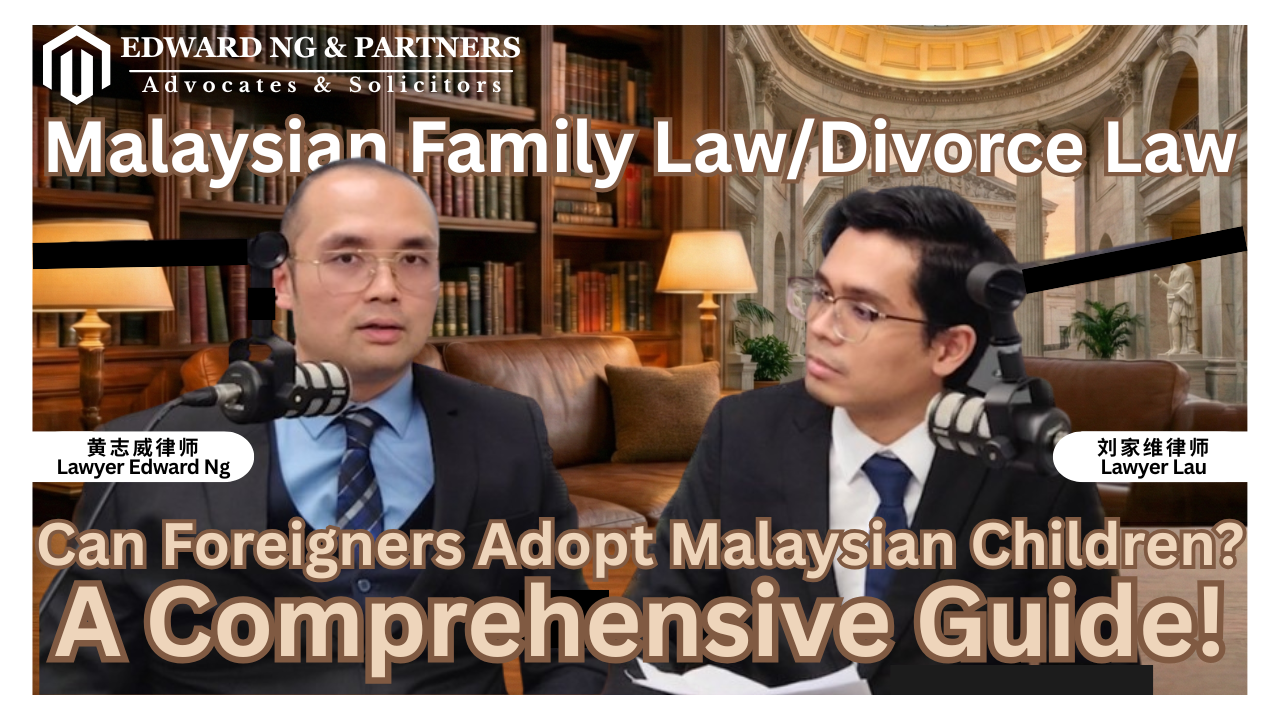
How Can Foreigners Adopt a Child in Malaysia ? A Complete Step-by-Step Guide !

How Can Foreigners Adopt a Child in Malaysia ? A Complete Step-by-Step Guide !

This Episode Discusses a More “Cross-Border” Issue: Can Foreigners Adopt Malaysian Children in Malaysia? What Procedures and Key Considerations Are Involved if the Child Is Later Taken Abroad? 1) First Clarify: What Is Meant by “Foreign Adoption”? It can generally be divided into two situations: (A) One spouse is a…
What If the Other Party Converts to Islam During the Tribunal Exemption Process?

What If the Other Party Converts to Islam During the Tribunal Exemption Process?

In matrimonial matters, a common question arises: if one party is in the process of applying for a “tribunal exemption,” and the other party suddenly converts to Islam, will this affect the divorce proceedings? First, it depends on the stage of the process. If the exemption application has just begun…
If You Have Already Gone to Court for Child Custody, Can You Skip JPN in Divorce Proceedings?Part 2

If You Have Already Gone to Court for Child Custody, Can You Skip JPN in Divorce Proceedings?Part 2

Many people attempt to link “custody orders” with “divorce proceedings,” assuming that if both parties are already complying with a custody order, the divorce process should become simpler, or even qualify for procedural exemptions. However, in essence, these remain separate matters. If both parties comply with the custody order—maintenance is…
If You Have Already Gone to Court for Child Custody, Can You Skip JPN in Divorce Proceedings?Part 1

If You Have Already Gone to Court for Child Custody, Can You Skip JPN in Divorce Proceedings?Part 1

In handling family matters, many people tend to confuse “child custody” with “divorce.” However, in law, these are entirely separate procedures. Some parents, even before divorce, have already applied for and obtained a court order regarding child custody. Such orders may include guardianship, visitation rights, and even maintenance (child support)…
If One Party Is Living Overseas and Not Returning to Malaysia, Can This Be a Ground for Divorce?

If One Party Is Living Overseas and Not Returning to Malaysia, Can This Be a Ground for Divorce?

Can a Partner Living Overseas for a Long Period Constitute a “Special Circumstance”? There are indeed such situations: The other party has been living abroad for many years It is confirmed that the person is in a certain country It is even known that the person holds residency rights in…
Does the Other Party’s Imprisonment Affect Divorce?

Does the Other Party’s Imprisonment Affect Divorce?

In legal proceedings, certain situations may allow exemption from mediation or special procedural treatment, one of which is the other party being in prison. However, not all imprisonment cases qualify, as the law sets clear conditions. Imprisonment as a “Special Circumstance” Condition The law generally stipulates: imprisonment of five years…
Special Circumstances in Divorce: Do Domestic Violence or Emotional Abuse Count? Uncovering the Grey Areas!Part 2

Special Circumstances in Divorce: Do Domestic Violence or Emotional Abuse Count? Uncovering the Grey Areas!Part 2

In legal proceedings, domestic violence does not only refer to physical harm; psychological abuse may also be regarded as a “special circumstance.” However, the key issue in law is evidence. Can Psychological Abuse Be Considered a “Special Circumstance”? In principle: yes, because psychological abuse can also cause serious stress, anxiety,…
error: Content is protected !!
Welcome to Edward Ng & Partners! Click to consult with our lawyer! 欢迎来到爱德华·黄律师事务所,点击联系我们的律师
//
Lawyer Edward Ng 黄志威律师 황지위 변호사
Divorce, Child Adoption, Will, Probate & LA, CIPAA, Civil & Corporate Litigation, Debt Recovery, Defamation, Tax Law.
Consult Lawyer 咨询律师 상담문의